Pages

Free counters!
FollowLike Share It

Saturday, 26 November 2011

The People's Surveillance State

The People's Surveillance State

by: William Rivers Pitt, Truthout | Op-Ed

Police pepper spray students at a UC Davis demonstration on Friday, November 18. (Screengrab: OperationLeakS - Click here for video)
All tyrannies rule through fraud and force, but once the fraud is exposed they must rely exclusively on force.
- George Orwell
In the aftermath of September 11, there was a big push to create a national surveillance system in the name of national security. Cameras were installed at traffic lights, ostensibly to catch people running red lights and stop signs, but those cameras came with a nifty side benefit: they recorded everyone within reach of the lens in their comings and goings. Cameras were installed at street corners, ostensibly to provide security against crime, but again, you were recorded wherever you went. Bank machines all come with security cameras, and those added to the ever-broadening web of national surveillance. Finally, almost every cell phone now comes with software that, so long as the thing is turned on, can track your every step by triangulating your position via GPS and the cell towers your phone signal bounces off of.
Those with a fealty to the quaint ideals of American civil liberties had, to no great surprise, a big problem with putting this system in place. Combine the concern over having millions of innocent people on camera with the fact that the Bush administration decided to spy on pretty much everyone by way of the NSA because no one had the guts to stop them, and what you had - and have to this day - is a pretty damned paranoid situation where everyone is being watched by The Man. Today, it is almost impossible to be anywhere in America without something tracking you. After this technology had been in place for a few years, it even became fodder for cop shows; half the episodes of "Law & Order: SVU" after 2008 involve catching criminals using this web of eyes and ears. As you can imagine, the bad guys almost never got away.
The basic idea behind setting up this incredibly invasive system, if you listen to its advocates, is that security is paramount in the aftermath of 9/11. There were plenty of people, after the Towers came down, who were very happy to surrender their liberties in the name of security, despite Benjamin Franklin's warning about deserving neither and losing both. Nowadays, the existence of such a system is established fact, leading to yet another bout of cognitive dissonance: those in favor of such a system a few years ago, because it meant the state was looking out for their safety, are now in all likelihood the same people railing against the state with guns on their hips at Tea Party rallies...but that's a brain cramp to be dealt with another day.
The advent of the Occupy movement, the length of time that movement has been able to hang fire, and the vast number of cities in which it is taking place, has led to an astonishingly violent reaction from the very state we are supposedly trusting to watch over our every move. There have been a dozen incidents of gruesome official violence against peaceful, non-violent protesters, including the near-murder of an Iraq war veteran by police in Oakland...violence the likes of which has not been seen in America since the dogs and firehoses days of Birmingham, Alabama.
Last Friday, students at UC Davis in California were subjected to an attack by police that beggars likeness. Here's the thing, though: this time, it's all on film.
If you haven't seen it yet, what you're looking at is a dozen or so protesters seated with their heads down, arms linked, in peaceful non-violent resistance. An armored UC Davis police officer calmly pulls out a can of pepper spray the size of a fire extinguisher, shakes it up, and hoses these seated students down from one side to the other and then back again. Several of the students subjected to this attack required hospitalization, and there is an unconfirmed report that one of the protesters had a UC Davis cop shove the nozzle of his pepper spray canister into her mouth and then pulled the trigger.
It is all on film.
It is all on film.
It is all on film.
The chancellor of UC Davis is under intense pressure to resign her post. The officers involved in this unprovoked attack have been suspended, and an official investigation is underway.
None of which would be true if the incident was not all on film. The video of the attack on YouTube, at the time of this writing, has almost 1,400,000 views, and similar attacks by police have been captured on film from one side of the country to the other.
Memo to the police and the surveillance state you represent: you are not working in the dark anymore. You may have your own system of surveillance, but We The People are watching you just as closely, and we have our own system of surveillance. It's called exposing your vicious, anti-American and thoroughly unnecessary strong-arm tactics for all to see. It is really very easy, takes no time, and we will make you famous in all the wrong ways before you take your shoes off at bedtime. The name, telephone number and email address of the cop who attacked those UC Davis protesters is now common knowledge on the internet, and while I will not publish it here, that cop should know down to his cowardly little bones that he is right out there under the bright lights, thanks to the People's Surveillance State.
You may be watching us, but by God and sonny Jesus, we are watching you.

Prosecutor: Reagan, Bush not criminally liable

Posted: 3:57 p.m. today 
Updated: 5:21 p.m. today

Prosecutor: Reagan, Bush not criminally liable

By PETE YOST, Associated Press
WASHINGTON — One of the prosecutors who investigated the Iran-Contra affair concluded two decades ago that neither Ronald Reagan nor George H.W. Bush was criminally liable in the scandal that tarnished the presidencies of both men, according to reports made public Friday.
Associate independent counsel Christian Mixter reached that conclusion in 1991 even though he found that President Reagan was briefed in advance about every weapons shipment sold to Iran in the arms-for-hostages deals in 1985-86. In a separate report on Bush, Mixter wrote that the then-vice president was chairman of a committee that recommended mining the harbors of Nicaragua in 1983.
Mixter's reports were obtained through a Freedom of Information Act request from the National Security Archive, a nonprofit research group, which released them on the 25th anniversary of the Iran-Contra scandal. At a Nov. 25, 1986, White House news conference, Reagan and then-Attorney General Edwin Meese disclosed that money from the arms sales to Iran had been diverted to the Contra guerrillas fighting the leftist government of Nicaragua after Congress had cut off military aid to the rebels.
Mixter concluded it would be difficult to prosecute Reagan for violating the Arms Export Control Act mandating congressional notification of arms transfers through a third country — Israel in the case of the Reagan White House's secret arms sales to Iran in 1985. The reason, said Mixter, was that Meese had told Reagan the National Security Act could be invoked to supersede the export control act.
Mixter's March 1991 reports to his boss, Independent Counsel Lawrence Walsh, and his team of prosecutors noted that they were actively investigating Bush, who by then had become president.
"As we have discussed," Mixter wrote to Walsh and the other prosecutors, "there is an outstanding area of investigation that could conceivably lead to wholly new evidence regarding Mr. Bush's role in Iran-Contra." The topic concerned possible knowledge by Bush of secret military support for the Contras, including the recommendation to mine the Nicaraguan harbors.
A year after Mixter wrote his reports, Walsh obtained a grand jury indictment charging former Reagan administration Defense Secretary Caspar Weinberger with concealing his detailed notes of the controversy from investigators.
Bush pardoned Weinberger and five other Iran-Contra figures shortly before the former defense secretary was to go on trial in a case in which Bush could well have been summoned as a witness either by prosecutors or defense attorneys.
In a final report by prosecutors released in 1994 more than a year following Bush's pardons, Walsh stated that Reagan acquiesced in a cover-up that had been spearheaded by Meese and carried out at the top levels of the Reagan administration. The report was immediately denounced by Reagan, Meese, Bush and others. Impeachment of Reagan "certainly should have been considered" by the congressional committees investigating the Iran-Contra affair, Walsh told a news conference at the time.
Mixter's reports on Reagan and Bush reflect the absence of evidence demonstrating that Reagan or Bush hid information from investigators. Both men participated in meetings of Reagan and his inner circle in which one or the other covert operations was discussed.
"I conclude that President Reagan lacked sufficient information" about what the National Security Council staff was doing, "and the manner in which Congress was deceived, to support a criminal charge that he conspired" with others indicted in the scandal, Mixter wrote.
"The record on President Reagan's awareness of these congressional inquiries is somewhat muddy," said Mixter. "There is no indication that Mr. Reagan was aware of, or played any conscious role in, the administration's efforts to deflect congressional inquiries into the shootdown" of one of the planes secretly supplying arms to the Contras, says Mixter's report.
As for the report on Bush, Mixter wrote: "Although the quantity of information compiled by Mr. Bush's Iran-Contra activities is much smaller than that amassed on former President Reagan, it is quite clear that Mr. Bush attended most — although not quite all — of the key briefings and meetings in which Mr. Reagan participated."
The report went on: "However, if then-President Reagan faces no criminal liability for having 'authorized' any of the core Iran-Contra events of which both he and Mr. Bush were aware, then there is no basis on which to find a secondary officer like Mr. Bush liable for simply 'being there' while those events were discussed with the president."
Peter Kornbluh, the National Security Archive analyst who obtained the Mixter reports under the FOIA, called them "the verdict of history on the Iran-Contra roles of both the president and vice president of the United States."

Bangladesh: International anti-imperialism conference

Dhaka, Nov 25 (bdnews24.com)—Former prime minister of Nepal and chairman of the United Communist Party of Nepal (Maoist) Pushpa Kamal Dahal Prachanda is coming to Dhaka on Saturday to join an anti-imperialism international conference. 

Representatives from 27 countries, including former US attorney general Ramsey Clark, and Socialist Unity Centre of India (Communist) leader Manik Mukherjee are scheduled to attend the conference, co-organiser Bangladesher Samajtantrik Dal (BaSaD) general secretary Khalequzzaman said at a press briefing on Friday. 

BaSaD is organising the three-day conference, to be held from Sunday, jointly with Anti-imperialist and People's Solidarity Coordinating Committee (IAPSCC). 

This is the third anti-imperialism international conference. The other two were held in India and Lebanon. 

Khalequzzaman said issues on imperialist aggression in several countries will be discussed in the conference. The 31st founding anniversary of BaSaD will also be celebrated, he added. 

Prachanda was a former guerrilla who led the Communist Party of Nepal (M) when it launched an insurgency in 1996. In 2008 the ensuing civil war culminated in the overthrow of the Shah dynasty. More than 15,000 Nepalese had died the conflict. 

The Constituent Assembly elected Prachanda prime minister of Nepal in August 2008 and he resigned from the post in May 2009 after his attempt to sack General Rookmangud Katawal, the army chief, was opposed by president Ram Baran Yadav. 

http://bdnews24.com/details.php?id=212140&cid=2

Media Lies Used to Provide a Pretext for Another "Humanitarian War": Protest in Syria: Who Counts the Dead?


By Julie Lévesque

URL of this article: www.globalresearch.ca/index.php?context=va&aid=27785

Global Research, November 25, 2011


According to numerous reports from the Western media, human rights organisation, as well as the UN, countless peaceful civilians have been killed by the Syrian forces since the beginning of the unrest in the country in mid March. But where do the numbers come from?
Many media reports on the alleged deadly repression by the Syrian government fail to mention the sources of their information, which are very often referred to solely as "human rights groups" or "activists":
"Rights groups said Sunday that troops cracking down on pro-democracy protesters killed eight people in northern Idlib province and four more in central areas near Hama. (Syrian Forces Kill 12 as ICRC Head Visits Damascus, Voice of America, September 4, 2011.)
These protests are an unprecedented challenge to President Bashar al-Assad — and his family, which has ruled the country for more than 40 years. The cost has been high: at least 200 dead, according to human rights groups, and many cyber activists have been jailed. (Deborah Amos, Syrian Activist In Hiding Presses Mission From Abroad, NPR, April 22, 2011.)
At least 75 people have been killed today in Syria during mass protests, local human rights activists told Amnesty International [...]
Thirty were killed in the southern town of Izzra’, 22 in Damascus, 18 in the Homs area and the rest in other towns and villages, activists said [...] (Scores killed in Syria as 'Great Friday' protests are attacked, Amnesty International, April 22, 2011.)
Although the necessity to remain "anonymous" where dissent is said to be life threatening may under certain circumnstances be understandable, this stance inevitably raises suspicions: The "'numbers" can be used to demonize the government, as part of  covert operations by any state or organisation looking for regime change in Damascus. It is no secret that the overthrow of the Syrian regime has been a long-sought goal by several foreign powers, including the U.S. and Israel.

The reliance of the mainstream media on information emanating from anonymous groups provides a biased understanding of the Syrian protests, which in turn supports the broader objective of destabilizing the Syrian regime.

When information from unknown sources pertaining to the death toll is published either by a mainstream media or a recognized human rights group, it is invariably picked up and considered as "factual evidence" by other news sources or think tanks, without further verification. Moreover, intghe process the information is subject to further distortion. Here is an example of this phenomenon:
Rights group Amnesty International said on Friday that it has recorded the names of 171 people killed since the first protesters died in Daraa on March 18.
The group based its tally on information received from rights activists, lawyers and other sources and said the majority appeared to have been killed by live ammunition fired by the security forces. (Protesters killed in southern Syria, Al Jazeera, April 9, 2011.)
The above news article is based on trhe following statenment by Amnesty International:

At least 171 people are believed to have been killed during three weeks of unrest in Syria, Amnesty International said today after at least eight more fatalities during protests.
The death toll from today's clashes could rise significantly, according to reports from human rights activists in the country.
Amnesty International has recorded the names, via information received from sources including human rights activists and lawyers, of 171 people killed. (Death toll rises amid fresh Syrian protests, Amnesty International, April 8, 2011.)
The original information from Amnesty international (AI) is that “171 people are believed to have been killed”, a statement showing that although “it has recorded the names of 171 people killed”, this information could not be confirmed. Al Jazeera fails to report this "uncertainty" and by doing so makes it a fact rather than an assumption, that 171 people were killed.
Here is another example of blatant distortion:
Despite a pledge to end its crackdown, Syrian security forces continued to suppress anti-regime protestors, killing at least eighteen on Thursday in the city of Homs (al-Jazeera). (Jonathan Masters, Assad's Broken Promises, Council on Foreign Relations, November 3, 2011.)
This is an analysis from the Council on Foreign Relations, the famous and extremely powerful U.S. foreign policy think tank [1]. It is based on the following article from Al Jazeera where the information related to the killing is markedly different:
"Dozens of people have reportedly been killed in the flashpoint city of Homs, as Syrian security forces bombarded residential areas with tanks.
The reported deaths occurred in the Bab Amro district of Homs on Thursday, the Local Coordination Committees of Syria, an activist group monitoring the country's uprising, said. (Syria “violence defies peace deal”," Al Jazeera, November 4, 2011.)
Al Jazeera’s wording “reportedly been killed” and “reported deaths” shows the deaths have not been confirmed. The Qatari media also mentions that these claims come from one source only, namely from an activist group called Local Coordination Committees of Syria (LCC). The article from the CFR changed Al Jazeera’s allegations into concrete facts.
When it comes to counting the dead, the LCC is very often cited in the mainstream media as a source for reports on killings committed by the Syrian authorities, as we can see in the examples below:
Another opposition group, the Local Coordination Committees, said it could not corroborate the Syrian Observatory’s account of the military casualties, though it also called Monday one of the uprising’s bloodier days, with at least 51 civilians killed. “We don’t have any confirmation of what they’re claiming,” said Omar Idlibi, a spokesman for the Local Coordination Committees. (Nada Bakri and Rick Gladstone, Syria Faces New Threats as Opposition Seeks Allies, The New York Times, November 15, 2011.)
According to the opposition network, the Local Coordination Committees, at least five people were killed during the military offensives -- three in the central province of Homs, one in the eastern border town of Tal Kalakh and one in Idleb along the Syrian-Turkish border. (Roula Hajjar, Syria: Activists report manhunt for defectors and protesters, Los Angeles Times, September 5, 2011.)
Secret police opened fire and shot teargas to disperse more than 10,000 protesters in Deir Ezzour, in Syria’s tribal east, an activist from the Syrian Revolution Coordinators Union (SRCU) told Al Jazeera. Ten protesters were wounded and around 40 were arrested, he said.
The SRCU is the name given this week to one of Syria's grassroots opposition networks. The SRCU works alongside the Local Coordinating Committees (LCC), another grassroots opposition network. (Al Jazeera Live Blog – Syria, June 3, 2011.)

At least 2,200 people have been killed in Syria since the beginning of the unrest, by the United Nations’ count. An activist group, the Syrian Revolution Coordinating Union, said on Tuesday that 551 people were killed during Ramadan alone. The group said 130 others were killed on July 31, the eve of Ramadan, in an attack on the city of Hama, which was also the scene of a ferocious crackdown in 1982.
On Tuesday, four people were killed in Hara and two others in Inkil, two towns in Dara’a Province, according to the Local Coordination Committees, another group of activists who document demonstrations. (Nada Bakri, Syrian Security Forces Fire on Worshipers as Ramadan Ends, The New York Times, August 30, 2011.)
The above article mentions a "UN count" as if it were an independent source of information. However, according to one of its reports, the UN also relies on the same sources of information, the LCC, and it mentions in a note that it is unable to confirm if the information given by the LCC is true:

"At the time of writing, the mission had received more than 1,900 names and details of persons killed in the Syrian Arab Republic since mid-March 2011; all are said to be civilians [26]
26. This information is compiled by local coordinating committees active within the Syrian Arab Republic in documenting the names and details of victims. The mission is unable to verify independently this information." (United Nations, Report of the United Nations High Commissioner for Human Rights on the situation of human rights in the Syrian Arab Republic - A/HRC/18/53, September 15, 2011.)

What are the Local Coordination Committees (LCC)?
According to the Christian Science Monitor, the LCC is part of the non-elected Syrian National Council (SNC). Even though most of its members are in exile and its members in Syria are unknown, the SNC is presented as the legitimate Syrian authority, and has been recognized by the National Transitional Council of Libya, another non-elected body recognized by Western powers as a "pro-democracy" representative of the Libyan people.

"Syrian opposition leaders meeting Sunday in Turkey formally created the Syrian National Council, bringing together most of the disparate groups seeking to unseat Syrian President Bashar al-Assad.
The council includes the Local Coordination Committees, which has organized most of the protests across the country; the Syrian Muslim Brotherhood; and Kurdish groups; among others, the Associated Press reports. Almost half the members are from inside the country, according to the Washington Post, overcoming a key concern that the council would rely to (sic) heavily on exiles. (Ariel Zirulnick, Syrian oppositon groups formally unify, overcoming key hurdle, October 3, 2011.)
The LCC are somewhat "anonymous". They refused a telephone interview, but agreed to answer some questions by email. They stated that for security reasons they could not reveal how many members the LCC includes, but claim 13 members of the LCC are in the SNC. “We have enough people to run demonstrations on ground, for media and relief action.”


LCC Logo


The members allegedly come from different backgrounds and are from all age groups; some are active inside Syria, the others outside the country. The LCC says that their members, in and outside Syria, have been threatened, arrested and tortured by the Syrian authorities. When asked how they became a source of information for the foreign media, the LCC says it is because they provide credible facts.


And what is the ultimate goal of the LCC? “Our goal is to change the regime in Syria, and as the first step, to end the mandate of the current President, who is now politically and legally responsible for the crimes committed by his regime against the Syrian people and a safe transfer of power in the country.”


Basically, the LCC wants regime change in Syria and it seems to be the major source of information for the western mainstream media and human rights organizations. This opposition group claims to provide “credible facts”, however there is no way to verify these facts. The so-called facts could well be propaganda intended to discredit the actual regime and galvanize public opinion in favour of the regime change the group aspires to implement.


Although the LCC spokesperson refused to disclose the names of its members, some have appeared in the mainstream media. One of their members, or collaborator, is Rami Nakhle, a cyberactivist living in exile in Beirut, Lebanon.


“Today, after 98 days of protests, he is living in denial,” says Rami Nakhle, a Syrian working in Beirut with the Local Coordination Committees, a clearinghouse for Syrian opposition protests and activities “It has become clear to everybody that Bashar al-Assad cannot change. He doesn’t realize that Syria has changed forever but he’s still the same president we heard last time, in April.” (Nicholas Blanford, Assad's speech may buy time, but not survival, The Christian Science Monitor, June 20, 2011)
The activist has a privileged relationship with Al Jazeera, according to NPR:


When the Arabic channel Al-Jazeera broadcasts the latest news, the images come from Nakhle's network. (Deborah Amos, Syrian Activist In Hiding Presses Mission From Abroad, April 22, 2011.)
It should be noted that Al Jazeera played a key role in promoting the regime change in Libya.

CyberDissidents.org, a website presented by the Bush Center as a “Voice of Freedom Online”, offers a brief portrait of Nakhle, which is not unlike the other portraits found in the mainstream press, which describe him solely as a cyber-dissident, as if he never had any other occupation:

"Rami Nakhle is a 27 year cyber-dissident. His use of social media to spread information about the Syrian Revolution caught the attention of Syrian authorities, causing him to flee to Lebanon in January 2011. For the past three years, he has been working under the pseudonym Malath Aumran. Although the Syrian secret police have discovered his real identity, he continues to use this pseudonym to retain recognition from his online followers.

Despite these threats from the Syrian government, Nakhle continues to work in hiding, continuing his campaign for freedom through Facebook, Twitter, and full-access interviews with prominent news sources like BBC and The New York Times. (CyberDissident Database)


Portrait of Rami Nakhle on CyberDissident.org

The U.S. government and NGOs doing CIA work, such as Freedom House, are major sponsors of cyber-dissidence:

"Political dissidents from China, Iran, Russia, Egypt, Syria, Venezuela and Cuba will travel to Dallas to join with Fellows of the George W. Bush Institute, experts from Freedom House, Harvard’s Berkman Center for Internet and Society, the U.S. Government and other leaders in the field to discuss the successes and challenges of Internet-based political dissident movements around the world.

The George W. Bush Institute today [March 30, 2010] announced it will co-host a conference on cyber dissidents with the human rights organization Freedom House on April 19, 2010. (George W. Bush Institute and Freedom House to Convene Freedom Activists, Human Rights and Internet Experts to Assess Global Cyber Dissident Movement," Business Wire, March 30, 2011)
Rami Nakhle doesn’t hide his interests in American organisations. On his Facebook page, he lists the following as “interests”: National Democratic Institute (NDI), chaired by Madeleine Albright, Human Rights Watch and the U.S. Embassy Damascus.

Nakhle’s interest in these organisations clearly shows which side he’s on, just like SCN member Radwan Ziadeh, former fellow of the National Endowment for Democracy, another organization well-known for its links with the CIA.

In an interview with the Guardian, the cyberactivist claims to be harassed by the Syrian secret police, on his Facebook wall. It might be true, but it would be a rather unusual tactic for a secret police, which usually, as its name says, acts secretly. Such harassment is more likely to be black propaganda -- people opposed to the regime trying to make the Syrian authorities look bad. A kind of "cyber false flag" on Facebook, for everyone to see.

The "Syrian uprising" seems to be a copy and paste of the "protest movement" in Libya, which was conducive to a NATO invasion and regime change. The mainstream press has once again one principal source of information – the opposition groups. The media neglects military casualties and fails to report that armed gunmen, 17 000 according to a report from the International Institute for Strategic Studies, are among the protesters. A non-elected body, the SNC, ironically is upheld as a democratic movement and is offered "credibility" as well as extensive mainstream media coverage.


marxistindia news from the cpi(m)


marxistindia
news from the cpi(m)


November 26, 2011


Press Statement


The Polit Bureau of the Communist Party of India (Marxist) has issued the following statement:


The Confederation of All India Traders has given a call for a nationwide bandh on 1st December to protest against the Union Cabinet’s decision to allow FDI in retail trade.  The CPI(M) calls upon all its units and all sections of the people to support the call for a nationwide bandh on 1st December.


The Polit Bureau of the CPI(M) has already given a call to all its units to organise protest actions against this anti-people step and to defend the crores of small retailers and their families whose livelihood is under threat.

AFSPA will be revoked one day: Farooq

AFSPA will be revoked one day: Farooq

Saturday, 26 Nov 2011 at 12:52
New Delhi, Nov 25: The ruling National Conference president and union minister for new and renewable energy Farooq
Abdullah Friday said the contentious Armed Forces Special Powers Act (AFSPA) will be revoked “one day” from Jammu and Kashmir.
“AFSPA will be revoked one day,” Farooq said when asked whether the law that gives sweeping powers to the armed forces in fighting militants should be revoked from the state.
Asked what his views were on the matter, he said, “The chief minister will decide.”
To a question whether his son, Chief Minister Omar Abdullah would take his advice, Farooq laughed and walked away.
Farooq, who was thrice Chief Minister of the state, was visiting the Ministry of New and Renewable Energy stall at the India International Trade Fair here today.
http://www.risingkashmir.com/news/afspa-will-be-revoked-one-day-farooq-18515.aspx


Armed Forces (Special Powers) Act, 1958

From Wikipedia, the free encyclopedia
The Armed Forces (Special Powers) Act (AFSPA), was passed on September 11, 1958, by the Parliament of India.[1] It conferred special powers upon armed forces in what the act calls "disturbed areas" in the states of Arunachal Pradesh, Assam, Manipur, Meghalaya, Mizoram, Nagaland and Tripura. It was later extended to Jammu and Kashmir as The Armed Forces (Jammu and Kashmir) Special Powers Act, 1990 in July 1990.[2]

Contents

 [hide

[edit] The Act

The Articles in the Constitution of India empower state governments to declare a state of emergency due to one or more of the following reasons:
  • Failure of the administration and the local police to tackle local issues.
  • Return of (central) security forces leads to return of miscreants/erosion of the "peace dividend".
  • The scale of unrest or instability in the state is too large for local forces to handle.
In such cases, it is the prerogative of the state government to call for central help. In most cases, for example during elections, when the local police may be stretched too thin to simultaneously handle day-to-day tasks, the central government obliges by sending in the CRPF. Continued unrest, like in the cases of militancy and insurgence, and especially when borders are threatened, are the armed forces resorted to.[3]
By Act 7 of 1972, this power to declare areas as being disturbed was extended to the central government. [4]
In a civilian setting, soldiers have no legal tender, and are still bound to the same command chain as they would be in a war theater. Neither the soldiers nor their superiors have any training in civilian law or policing procedures. This is where and why the AFSPA comes to bear - to legitimize the presence and acts of armed forces in emergency situations which have been deemed war-like by local leaders which led to the armed forces' presence in the first place.[3][5]

[edit] Constitutionality and other issues

According to the Armed Forces Special Powers Act (AFSPA), in an area that is proclaimed as "disturbed", an officer of the armed forces has powers to:
  • "Fire upon or otherwise use force, even to the causing of death, against any person who is acting in contravention of any law" against "assembly of five or more persons" or possession of deadly weapons.
  • To arrest without a warrant and with the use of "necessary" force anyone who has committed certain offenses or is suspected of having done so
  • To enter and search any premise in order to make such arrests.
It gives Army officers legal immunity for their actions. There can be no prosecution, suit or any other legal proceeding against anyone acting under that law. For declaring an area as a 'disturbed area' there must be a grave situation of law and order on the basis of which Governor/Administrator can form opinion that an area is in such a disturbed or dangerous condition that use of Armed Forces in aid of civil power is necessary .[6]
The Act has been employed in the Indian administrated state of Jammu and Kashmir since 1990.[2] It was withdrawn by the Manipur government in some of the constituencies in August 2004 in spite of the Central government not favouring withdrawal of the act.
In December 2006, responding to what he said were 'legitimate' grievances of the people of Manipur, Prime Minister Manmohan Singh declared that the Act would be amended to ensure it was 'humane' on the basis of the Jeevan Reddy Commission's report, which is believed to have recommended the Act's repeal.[7]
Violence has increased in the past two decades since enforcement of the Act.[8] The state has created a "Gallantry Awards" pool for the arms forces which are awarded for elimination of insurgencies and conduction of operations. The term 'encounters' is used by the security forces to describe confrontations where it is deemed appropriate, under the provisions of the act, to employ violence.[8]
Protests began in Kashmir valley on Sep 10, 2010, on the occasion of Eid and turned violent on Sep 11, the anniversary of the controversial act. Indian Goverenment is considering partial withdrawal of the act.

[edit] The Jeevan Reddy Commission

In 2004, in the wake of intense agitation [9] that was launched by several civil society groups following the death of Thangjam Manorama, while in the custody of the Assam Rifles and the indefinite fast undertaken by Irom Sharmila, Union Home Minister Shivraj Patil visited Manipur and reviewed the situation with the concerned state authorities. In the same year, Prime Minister, Manmohan Singh assured activists that the central government would consider their demand sympathetically.
The central government accordingly set up a five-member committee under the Chairmanship of Justice B P Jeevan Reddy, former judge of the Supreme Court. The panel was given the mandate of "review[ing] the provisions of AFSPA and advis[ing] the Government of India whether (a) to amend the provisions of the Act to bring them in consonance with the obligations of the government towards protection of human rights; or (b) to replace the Act by a more humane Act."
The Reddy committee submitted its recommendations on June 6, 2005. However, the government failed to take any concrete action on the recommendations even after almost a year and a half. The then Defence Minister Pranab Mukherjee had rejected the withdrawal or significant dilution of the Act on the grounds that “it is not possible for the armed forces to function” in “disturbed areas” without such powers.[citation needed]
The 147-page report recommends, "The Armed Forces (Special Powers) Act, 1958, should be repealed." During the course of its work, the committee members met several individuals, organisations, parties, institutions and NGOs, which resulted in the report stating that "the Act, for whatever reason, has become a symbol of oppression, an object of hate and an instrument of discrimination and high handedness." The report clearly stated that "It is highly desirable and advisable to repeal the Act altogether, without of course, losing sight of the overwhelming desire of an overwhelming majority of the [North East] region that the Army should remain (though the Act should go)."[citation needed]
But activists say the Reddy panel despite its recommendation for the 'repeal of the Act' has nothing substantial for the people. The report recommends the incorporation of AFSPA in the Unlawful Activities (Prevention) Act, 1967, which will be operable all over India.[citation needed] On November 2, 2000, ten people were killed when a paramilitary force opened fire at a bus-stop near Malom in Manipur. Most of those killed were women and students. The firing was followed by a brutal combat operation also. A young lady, too shocked at the anarchical act of the state agencies, decided to begin a fast unto death demanding the repeal of the Act responsible for such brutality on the part of the state – the Armed Forces (Special Powers) Act, 1958. Thus began the fight of Irom Sharmila Chanu, the Iron Lady from Manipur whose fast completed 10 years this year.
The troops of 8th Assam Rifles were deployed in Malom to counter the ‘insurgent’ attack in the area. Those killed at the Malom massacre were L Sana Devi (60), G Bap Sharma (50), O Sanayaima (50), K Bijoy (35) A Raghumani (34), S Robinson Singh (27), Ksh Inaocha (23), T Shantikumar (19), S Prakash Singh (18) and S Chandramani (17).
Though Sharmila began her marathon fast in protest, the investigation into the Malom massacre has still not yet been completed even after 10 years. Following a directive of the Gauhati High Court, Imphal Bench, in 2004 and 2005, the District and Session’s Judge is conducting an enquiry into the incident. On January 7, 2010, a team of the court led by Th Surbala, the District and Session’s Judge, Manipur East, conducted a spot inquiry at Malom and investigation is on into the facts and circumstances leading to the firing incidents.
Since November 2, 2000, Sharmila has been arrested under section 309 of IPC which punishes attempted suicide by a one-year imprisonment. She is released every year to be arrested again. A compartment in the Jawaharlal Nehru Hospital has become her virtual nest, where the poet in Sharmila pens her verses. She turned down many requests to end her fast and expressed her firmness to continue her fast till the Act is repealed. She has been awarded with many laurels for her nonviolent contribution towards the human rights movement in north east India.
In a telephonic interview Sharmila’s brother Singhajit shared his memories of his sister’s childhood. He said, ‘Up to 10 years she was somewhat different from other children. She was a pure vegetarian. After passing class X, she started a training of yoga, nature cure and the holy Gita. She had only three-four friends. She liked to be alone listening to the radio, writing poems, shorthand writing etc. She was different. In October 2000, retired Justice Suresh from Bombay lead a commission and inquired about the Armed Forces Special Powers Act. Sharmila attended it as an individual activist. It was completed on 25th October, 2000. The Malom massacre took place on November 2. Ten people were killed near the airport in Malom. Sharmila began her fast after hearing the sound of the massacre on that Thursday. She informed some of her friends about her fast and then went to her mother to ask her permission for the fast. Mother gave her blessings and asked Sharmila to do whatever she could. She spent the night with her friends. On 5th, she went to the Malom Massacre site and sat there continuing her fast. In the early morning on 6th November, police arrested her and kept her in the custody. On November 11, 2000, I went to Sajowa jail and told her that we would fight together but she should give up her fasting. She replied, ‘Please come to encourage me and don’t come to discourage me’. At that moment, I promised her that I will be with her in her struggle. After returning from the jail, I resigned my job as an agriculture officer in a leading NGO called Citizen’s Volunteer Training Centre where I was drawing a handsome salary. I resigned to devote my time for Sharmila’s struggle and since then I am with her.’
When asked about the reaction of the state agencies when Sharmila decided to fast, Singhajit informed that the family members were threatened by the state agencies and were urged to sign in a letter for handing over Sharmila to the family. ‘But we believe that since Sharmila started her fast she is no more my sister, rather she is the sister of whole Manipur. We cannot sign in any paper asking to hand her over to our family’ he said.
Singhajit was emotional to answer his mother’s reaction over the whole incident. He said, ‘Our mother said that she feels happy when she gets the news about Sharmila’s achievement. But she feels sad whenever she remembers about her daughter. She passes several nights in tears. She believes that she will die after Sharmila’s death. This is her wish. She requested before the media that the central and state governments may decide to withdraw the AFSPA for at least 10 days so that she can meet her daughter before her death. Since Sharmila started her fast, the mother and daughter have never met as meeting may discourage Sharmila from continuing her struggle. Until and unless the mission is accomplished, the mother and daughter will never meet.’
Sharmila was honoured by the prestigious Gwangju Prize for Human Rights in 2007 by the May 18 Memorial Foundation in South Korea. The Prize was instituted to celebrate the spirit of the May 18 Gwangju Uprising by recognizing individuals, groups or institutions in Korea and abroad that have contributed in promoting and advancing human rights, democracy and peace in their work. In September this year, she was awarded the Rabindranath Tagore Peace award carrying Rs 51 lakhs, a gold medal and a citation. The Prize was presented to Sharmila by the Indian Institute of Planning and Management (IIPM) on September 11 at the JN Hospital.
To mark the completion of 10 years of Sharmila’s fast, the Just Peace Foundation (JPF), Manipur, has organized several programmes in Imphal under the name the Festival of Hope, Justice and Peace which will be held from 2 to 6 November 2010, in Imphal, Manipur. JPF informed that the Festival of Hope, Justice and Peace will be a celebration of the indefatigable spirit of humanity; a celebration of peace, justice and harmony; a celebration of the traditions and cultures of the North-east and its people; and a celebration of the Peoples’ Movement that has been going on for the last ten yea

[edit] Non-state views and commentary

[edit] United Nations view

When India presented its second periodic report to the United Nations Human Rights Committee in 1991, members of the UNHRC asked numerous questions about the validity of the AFSPA. They questioned the constitutionality of the AFSPA under Indian law and asked how it could be justified in light of Article 4 of the International Covenant on Civil and Political Rights, ICCPR. On 23 March 2009, UN Commissioner for Human Rights Navanethem Pillay asked India to repeal the AFSPA. She termed the law as "dated and colonial-era law that breach contemporary international human rights standards."[10]
The Attorney General of India responded that the AFSPA is a necessary measure to prevent the secession of the North Eastern states.[citation needed] He said that a response to this agitation for secession in the North East had to be done on a "war footing."[citation needed] He argued that the Indian Constitution, in Article 355, made it the duty of the Central Government to protect the states from internal disturbance, and that there is no duty under international law to allow secession.[citation needed]

[edit] Non-governmental organizations' analysis

The act has been criticized by Human Rights Watch as a "tool of state abuse, oppression and discrimination".[11]
The South Asian Human Rights Documentation Centre argues that the governments' call for increased force is part of the problem.[12]
"This reasoning exemplifies the vicious cycle which has been instituted in the North East due to the AFSPA. The use of the AFSPA pushes the demand for more autonomy, giving the people of the North East more reason to want to secede from a state which enacts such powers and the agitation which ensues continues to justify the use of the AFSPA from the point of view of the Indian Government." - The South Asian Human Rights Documentation Centre[13]
A report by the Institute for Defense Studies and Analysis points to multiple occurrences of violence by security forces against civilians in Manipur since the passage of the Act.[14] The report states that residents believe that the provision for immunity of security forces urge them to act more brutally.[14] The article, however, goes on to say that repeal or withering away of the act will encourage insurgency.
[15] In addition to this, there have been claims of disappearances by the police or the army in Kashmir by several human rights organizations.[16][17]
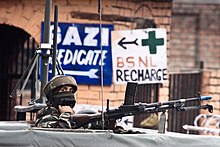
A soldier guards the roadside checkpoint outside Srinagar International Airport in January 2009.
Many human rights organizations such as Amnesty International and the Human Rights Watch (HRW) have condemned human rights abuses in Kashmir by Indians such as "extra-judicial executions", "disappearances", and torture;[18] the "Armed Forces Special Powers Act", which "provides impunity for human rights abuses and fuels cycles of violence. The Armed Forces Special Powers Act (AFSPA) grants the military wide powers of arrest, the right to shoot to kill, and to occupy or destroy property in counterinsurgency operations. Indian officials claim that troops need such powers because the army is only deployed when national security is at serious risk from armed combatants. Such circumstances, they say, call for extraordinary measures." Human rights organizations have also asked Indian government to repeal[19] the Public Safety Act, since "a detainee may be held in administrative detention for a maximum of two years without a court order.".[20]
The act has been cricised by many non governmental organisations and human rights activists. In J&K only, hundreds of people have been killed by security forces. Many cases of fake killings, binded labors, rapes and other atrocities have come in light.
Activists who are working in J&K for peace and human rights include names of Madhu Kishwar, Ashima Kaul, Ram Jethmalani, Faisal Khan, Ravi Nitesh, Swami Agnivesh, Dr. sandeep Pandey and many others. They all accept that people to people communication and development of new avenues are the only way for peace, however laws like AFSPA are continuously violating human rights issues there.

[edit] United States leaked diplomatic cables

The Wikileaks diplomatic cables have recently disclosed that Indian government employees agree to acts of human rights violations on part of the Indian armed forces and various paramilitary forces deployed in the north east parts of India especially Manipur. The violations have been carried out under the cover of this very act. Governor S.S. Sidhu admitted to the American Consul General in Kolkata, Henry Jardine, that the Assam Rifles in particular are perpetrators of violations in Manipur which the very same cables described as a state that appeared more of a colony and less of an Indian state.[21][22]
Earlier leaks had also stated that International Committee of the Red Cross (ICRC) had reported to the United States diplomats in Delhi about the grave human rights situation in Kashmir which included the use of electrocution, beatings and sexual humiliation against hundreds of detainees. This act is in force in Kashmir since 1990.[23]

[edit] See also

Irom Sharmila Chanu (born March 14, 1972), also known as the "Iron Lady of Manipur" or "Menghoubi" ("the fair one")[1] is a civil rights activist, political activist, and poet from the Indian state of Manipur. Since 2 November 2000, she has been on hunger strike to demand that the Indian government repeal the Armed Forces (Special Powers) Act, 1958 (AFSPA), which she blames for violence in Manipur and other parts of India's northeast.[2] Having refused food and water for more than 500 weeks, she has been called "the world's longest hunger striker".

On November 2, 2000, ten people were killed when a paramilitary force opened fire at a bus-stop near Malom in Manipur. Most of those killed were women and students. The firing was followed by a brutal combat operation also. A young lady, too shocked at the anarchical act of the state agencies, decided to begin a fast unto death demanding the repeal of the Act responsible for such brutality on the part of the state – the Armed Forces (Special Powers) Act, 1958. Thus began the fight of Irom Sharmila Chanu, the Iron Lady from Manipur whose fast completed 10 years this year.
The troops of 8th Assam Rifles were deployed in Malom to counter the ‘insurgent’ attack in the area. Those killed at the Malom massacre were L Sana Devi (60), G Bap Sharma (50), O Sanayaima (50), K Bijoy (35) A Raghumani (34), S Robinson Singh (27), Ksh Inaocha (23), T Shantikumar (19), S Prakash Singh (18) and S Chandramani (17).
Though Sharmila began her marathon fast in protest, the investigation into the Malom massacre has still not yet been completed even after 10 years. Following a directive of the Gauhati High Court, Imphal Bench, in 2004 and 2005, the District and Session’s Judge is conducting an enquiry into the incident. On January 7, 2010, a team of the court led by Th Surbala, the District and Session’s Judge, Manipur East, conducted a spot inquiry at Malom and investigation is on into the facts and circumstances leading to the firing incidents.
Since November 2, 2000, Sharmila has been arrested under section 309 of IPC which punishes attempted suicide by a one-year imprisonment. She is released every year to be arrested again. A compartment in the Jawaharlal Nehru Hospital has become her virtual nest, where the poet in Sharmila pens her verses. She turned down many requests to end her fast and expressed her firmness to continue her fast till the Act is repealed. She has been awarded with many laurels for her nonviolent contribution towards the human rights movement in north east India.
In a telephonic interview Sharmila’s brother Singhajit shared his memories of his sister’s childhood. He said, ‘Up to 10 years she was somewhat different from other children. She was a pure vegetarian. After passing class X, she started a training of yoga, nature cure and the holy Gita. She had only three-four friends. She liked to be alone listening to the radio, writing poems, shorthand writing etc. She was different. In October 2000, retired Justice Suresh from Bombay lead a commission and inquired about the Armed Forces Special Powers Act. Sharmila attended it as an individual activist. It was completed on 25th October, 2000. The Malom massacre took place on November 2. Ten people were killed near the airport in Malom. Sharmila began her fast after hearing the sound of the massacre on that Thursday. She informed some of her friends about her fast and then went to her mother to ask her permission for the fast. Mother gave her blessings and asked Sharmila to do whatever she could. She spent the night with her friends. On 5th, she went to the Malom Massacre site and sat there continuing her fast. In the early morning on 6th November, police arrested her and kept her in the custody. On November 11, 2000, I went to Sajowa jail and told her that we would fight together but she should give up her fasting. She replied, ‘Please come to encourage me and don’t come to discourage me’. At that moment, I promised her that I will be with her in her struggle. After returning from the jail, I resigned my job as an agriculture officer in a leading NGO called Citizen’s Volunteer Training Centre where I was drawing a handsome salary. I resigned to devote my time for Sharmila’s struggle and since then I am with her.’
When asked about the reaction of the state agencies when Sharmila decided to fast, Singhajit informed that the family members were threatened by the state agencies and were urged to sign in a letter for handing over Sharmila to the family. ‘But we believe that since Sharmila started her fast she is no more my sister, rather she is the sister of whole Manipur. We cannot sign in any paper asking to hand her over to our family’ he said.
Singhajit was emotional to answer his mother’s reaction over the whole incident. He said, ‘Our mother said that she feels happy when she gets the news about Sharmila’s achievement. But she feels sad whenever she remembers about her daughter. She passes several nights in tears. She believes that she will die after Sharmila’s death. This is her wish. She requested before the media that the central and state governments may decide to withdraw the AFSPA for at least 10 days so that she can meet her daughter before her death. Since Sharmila started her fast, the mother and daughter have never met as meeting may discourage Sharmila from continuing her struggle. Until and unless the mission is accomplished, the mother and daughter will never meet.’
Sharmila was honoured by the prestigious Gwangju Prize for Human Rights in 2007 by the May 18 Memorial Foundation in South Korea. The Prize was instituted to celebrate the spirit of the May 18 Gwangju Uprising by recognizing individuals, groups or institutions in Korea and abroad that have contributed in promoting and advancing human rights, democracy and peace in their work. In September this year, she was awarded the Rabindranath Tagore Peace award carrying Rs 51 lakhs, a gold medal and a citation. The Prize was presented to Sharmila by the Indian Institute of Planning and Management (IIPM) on September 11 at the JN Hospital.
To mark the completion of 10 years of Sharmila’s fast, the Just Peace Foundation (JPF), Manipur, has organized several programmes in Imphal under the name the Festival of Hope, Justice and Peace which will be held from 2 to 6 November 2010, in Imphal, Manipur. JPF informed that the Festival of Hope, Justice and Peace will be a celebration of the indefatigable spirit of humanity; a celebration of peace, justice and harmony; a celebration of the traditions and cultures of the North-east and its people; and a celebration of the Peoples’ Movement that has been going on for the last ten yea

[edit] Footnotes

  1. ^ “THE ARMED FORCES (SPECIAL POWERS) ACT, 1958”
  2. ^ a b “(PDF) The Armed Forces (Jammu and Kashmir) Special Powers Act, 1990” Indian Ministry of Law and Justice Published by the Authority of New Delhi
  3. ^ a b Harinder Singh (July 6, 2010). "AFSPA: A Soldier’s Perspective". Institute for Defence Studies and Analyses.
  4. ^ http://www.hindu.com/nic/afa/afa-part-ii.pdf
  5. ^ Anil Kamboj (October 2004). "Manipur and Armed Forces (Special Power) Act 1958". Institute for Defence Studies and Analyses.
  6. ^ ""Naga People's Movement of Human Rights vs. Union of India,1998"".
  7. ^ ""Humane garb for 'black law'"". December 3, 2006.
  8. ^ a b IDSA strategic analysis: Armed Forces Special Powers Act
  9. ^ "MANIPUR ON FIRE". Frontline. September 2004. Retrieved 2011-06-05.
  10. ^ "United Nations asks Indian govt to repeal AFSPA". IRNA. March 23, 2009. Retrieved 2009-03-24.
  11. ^ “Crisis in Kashmir” Council on Foreign Relations
  12. ^ India: Repeal Armed Forces Special Powers Act; 50th Anniversary of Law Allowing Shoot-to-Kill, Other Serious Abuses. Human Rights Watch
  13. ^ AFSPA South Asian HRDC
  14. ^ a b Institute for Defense Studies and Analysis, 'Manipur and Armed Forces (Special Powers) Act 1958' "the alleged rape and killing of Manjab Manorama", "security forces have destroyed homes", "arrests without warrants", "widespread violations of humane rights", "The cases of Naga boys of Oinam village being tortured before their mothers by Assam rifles Jawans in July 1987; the killing of Amine Devi and her child of Bishnupur district on April 5, 1996 by a CRPF party; the abduction, torture and killing of 15-year-old Sanamacha of Angtha village by an Assam Rifles party on 12th February 1998; the shooting dead of 10 civilians by an Assam Rifles party in November 2000 are some of the glaring examples that are still fresh in the mind of Manipuris."
  15. ^ "Blood Tide Rising". TIME Magazine. January 18, 1993.
  16. ^ India
  17. ^ BBC NEWS | World | South Asia | Kashmir's extra-judicial killings
  18. ^ Behind the Kashmir Conflict - Abuses in the Kashmir Valley
  19. ^ India: Repeal the Armed Forces Special Powers Act
  20. ^ Behind the Kashmir Conflict: Undermining the Judiciary (Human Rights Watch Report: July 1999)
  21. ^ Nambath, Suresh (March 21, 2011). "‘Manipur more a colony of India'". The Hindu (Chennai, India).
  22. ^ http://www.thehindu.com/news/the-india-cables/the-cables/article1556742.ece/ref>
  23. ^ Burke, Jason (December 16, 2010). "WikiLeaks cables: India accused of systematic use of torture in Kashmir". The Guardian (London).

http://en.wikipedia.org/wiki/Armed_Forces_%28Special_Powers%29_Act,_1958

Nato helicopters 'kill Pakistan checkpoint soldiers'


Nato helicopters 'kill Pakistan checkpoint soldiers'

Map
Pakistani officials have accused Nato helicopters of firing on a military checkpoint near Pakistan's Afghan border, killing 26 soldiers.
The "unprovoked and indiscriminate" attack took place in Mohmand tribal region, the Pakistani military said.
In response, Pakistan has closed the border crossing for supplies bound for Nato forces in Afghanistan.
The Nato-led force in Afghanistan says it is investigating and has offered condolences to any affected families.
The alleged attack took place at the Salala checkpoint, about 1.5 miles (2.5 km) from the Afghan border, Reuters reports, at around 02:00 local time (21:00 GMT).
Two officers were among the dead, officials said, and seven soldiers were reported wounded.
Prime Minister Yousuf Raza Gilani "has strongly condemned the Nato/Isaf (International Security Assistance Force) attack on the Pakistani post," the foreign ministry announced according to AFP news agency.
"On his directions, the matter in being taken up by the foreign ministry, in the strongest terms, with Nato and the US," it added.
The BBC's Shoaib Hasan in Karachi says Pakistani officials are furious, arguing there was no militant activity in the area at the time.
The incident risks dealing a fresh blow to US-Pakistan relations, which had only just begun to recover following a unilateral US raid that killed Osama Bin Laden in Pakistan in May.
Heartfelt condolences'
A senior Pakistani military officer told Reuters news agency that efforts were under way to transport the bodies of the dead soldiers to Mohmand's main town of Ghalanai.
"The latest attack by Nato forces on our post will have serious repercussions as they without any reasons attacked on our post and killed soldiers asleep," he said, requesting anonymity because he was not authorised to talk to the media.
Masood Kausar, governor of Khyber Pakhtunkhwa province, reportedly condemned the attack as "unacceptable and intolerable".
In a statement, Isaf commander Gen John R Allen said the incident "has my highest personal attention and my commitment to thoroughly investigate it to determine the facts.
"My most sincere and personal heartfelt condolences go out to the families and loved ones of any members of Pakistan Security Forces who may have been killed or injured."
In apparent response to the attack, lorries and fuel tankers were being stopped at Jamrud town in the Khyber tribal region near the city of Peshawar, officials and local media said - part of a key supply route which delivers 80% of Nato's equipment to Afghanistan.
"We have halted the supplies and some 40 tankers and trucks have been returned from the check post in Jamrud," Mutahir Zeb, a senior government official, told Reuters.
Pakistani troops are involved in fighting the Taliban in the crucial border region area. Hundreds of militants have been resisting attempts by the security forces to clear them from southern and south-eastern parts of the district.
Anti-militant operation The checkpoint at the centre of this latest incident was set up to prevent insurgents crossing over the border into Afghanistan, our correspondent says.
He says the movement of insurgents from the area into Afghanistan has been a concern for the Nato-led Isaf and the US.
The US has been targeting militants in Pakistan's tribal areas near the Afghan border for several months, often using unmanned drone aircraft.
Last year, US helicopters accidentally killed two Pakistani soldiers near the border, also prompting Pakistan to temporarily close the border to Nato supplies.
In October, Pakistan's army chief Ashfaq Kayani warned the US against taking unilateral action in nearby North Waziristan.
He said that the US should focus on stabilising Afghanistan instead of pushing Pakistan to attack militant groups in the crucial border region.
Washington has for many years urged Islamabad to deal with militants in the area.
 http://www.bbc.co.uk/news/world-asia-15901363