Pages

Free counters!
FollowLike Share It

Sunday, 1 January 2012

Imran Khan, Reality and Delusion

Imran Khan, Reality and Delusion
By S.M.A Ehtisham MD
Bath , NY
 
Imran Khan, after floundering for over a decade, has found focus. He appealed to people of Pakistan at a time of worse desperation than at any time since the creation of the country, except in 1971 and the people in the Punjab responded.
And Punjabis constitute62% of the population of the country.
He has offered a solution to all the problems of the country from feudalism, corruption, tax evasion, poverty alleviation, administrative inefficiency, illiteracy, unemployment to dependence on foreign countries.
Almost every one attributes the bulk of the problems in Pakistan to ‘corruption’ in all walks of life. But the USA and Pakistan are no different.
People do not pay taxes in Pakistan, they cheat and lie, officials demand bribes, the rich deposit money in foreign banks and politicians do not keep their word. Well, in the USA, all corporations practice tax evasion, nearly all affluent persons invent expenses to take advantage of tax loopholes, immigration officials smuggle illegal aliens for a price, most of the profits of corporation take shelter on off shore banks and all politicians, including Obama, have broken their promise.
Pakistan allocates 75% of the budget to defense and loan repayment, almost equally divided between the two. The declared US defense budget at $550 billion is 40% of the annual budget. The hidden budget for aggression is camouflaged in payment to mercenaries, corporations and foreign agents. Wastage is on top of that. Credible estimate for undeclared defense expense is 10 % of the budget - that takes it close to the Pakistan level.
So the question to ask is why the USA is doing relatively well and why Pakistan is on the brink of disaster? A larger picture would include the comparative development of India which is equally beset by corruption.
One could point to the much larger pie of the USA, and in relation to India the comparative destitution of Pakistan at the time of partition.
But Pakistan was endowed with the monopoly of jute and the fertile lands of the Punjab and Sind and India had to resort to officially backed rice and wheat smuggling from Pakistan. The Nizam of Hyderabad ‘loaned’ Rs 2,000 million, at the time equivalent to two years annual budget, to Pakistan and the Korean War was a veritable export bonanza for Pakistan’s exports.
Ayub promoted industry in a significant way and till the end of his time the country was far more prosperous than India.
So what are the core problems of the country and how Imran Khan proposes to deal with them and, more importantly, if he is even aware of them?
Population Explosion: West Pakistan, and since 1971, all of Pakistan, inherited a population of 35 million in 1947. 98% of the people were Muslim. Now conservative estimates put the number at 175 million, a 500% increase. India had a population of 320 million, out of which 20 million were Muslim. Now its total population has gone up to 1,150, a 350% increase. But the Muslim population of India has gone up from 20 to125 million, a mind-boggling 62.5 % increase.
Economic conditions, percentage of literacy and social development play a part in population explosion. But a major role is played by prohibition of family planning, which is practiced on a large scale by non-Muslims of India.
Foreign Policy: It is a largely forgotten fact that the Communist Party of India, at the behest of Stalin, supported the Pakistan movement. The USSR sent an invitation to Liaquat Ali Khan before the USA did. Liaquat, scion of a feudal house, decided to go to Washington DC.
The USSR supported India in industry, commerce and defense sectors. The USA just patted Pakistan on the back.
Bureaucrats took over the government after Prime Minister Liaquat was killed. The Army started playing a role in politics and Ayub started visiting Washington, DC. Come 1954, Pakistan started participating in ‘Mutual Defense Pacts’ in the hope, which turned out to be vain, that the West would support it in its conflict with India.
Pakistan started receiving ‘aid’ in the form of weapons.
Domestic Front: Bureaucrats, mortally afraid of the January 1959 elections, handed over power to the army. Ayub, beset by the aftermath of the fraudulent victory over Miss Jinnah in the 1964 elections, launched the adventure of the 1965 war, lost it and was disempowered.
The inevitable happened. The mercantilist party of Mujeeb won an overall majority. Feudal Bhutto won’t accept it. The evil quad of landowners, the army, bureaucrats and mullahs joined hands and waged a war of terror against the people of East Pakistan.
 Bhutto took over West Pakistan and lost the last chance to control the army by pleading with Indra not to try Pakistani generals on charges of genocide. Further, true to the character of a feudal, he demolished the nascent commerce and industries of the country under the slogan of nationalization imposed in the most ham handed fashion.
Not content with sabotaging the economy, he launched grandiloquent plans of the Islamic bloc and bomb, further impoverishing the country.
The U.S.A is highly tolerant of dictators but not the once who are even a remote threat to Israel . Bhutto paid the price of defiance with his life.
Islamization:
The USSR gave a much longed for opportunity to the U.S.A to avenge the humiliation of Vietnam by going into Afghanistan . Loans poured in Pakistan .
Zia with his ‘Islamization’, Benazir and Nawaz with their musical chairs and Musharraf with his enlightened moderation did not do a thing to restructure the economy, create jobs, improve literacy or create jobs.
Musharraf sold national assets at bargain basement price.
The country only got further into the clutches of Multinational Corporations and their functional arms, the International Monitory Fund, The World Bank and other International Financial institutions. Recipient countries end up paying several times what they received.
How does Imran Khan propose to deal with the issues?
Let us look at the manifesto:
-A new beginning: Modern Islamic Republic, tolerance, moderation and freedom to practice religion of choice.
-Ideology: Unity, Faith and Discipline of Jinnah vintage, transparency and 1973 constitution, federalism and functional autonomy of the provinces.
Mission : rule of law, Human rights.
-Goals: independent, sovereign Pakistan, strengthen state institutions, promote democracy, accountable, efficient government, education revolution, adequate health care, poverty alleviation (land reforms), merit based system, encourage private sector, end VIP culture, eliminate draconian laws and check police and agency power, independence from foreign aid, regional peace.
Islamic Republic, I take it, would be governed under Sharia laws. That would be in conflict with equality under law for women (half the vote and half the inheritance and possible one fourth share of husband and depending on financial resources of the husband sharing the marital bed with women under the right hand.
Minorities would not have equal rights either. They would not be able to appear in court as witnesses for or against Muslims or join the army or preside over a court to try Muslims. They will also have to pay ‘Jazya’.
The above would take care of Human Rights as understood in this day and age.
Though Islam does not prescribe a system of government, sovereignty belongs to Allah and democracy, at least in theory, stands for sovereignty of the people.
Poverty alleviation would be based partly on land redistribution. But Islam sanctifies private property. I suppose landowners would out of the goodness of heart donate land to landless peasants.
A revolution would be ushered in education. Education requires teachers, books, buildings and students. Where would the money come from to pay teachers, buy books and construct schools? And how would the poor people be persuaded to keep their children from work to help meet bare necessities and go to school?
Adequate health care requires a national health service. A minimum of one physician per 1000 people, a hospital bed per 500 persons, surgical and intensive care corresponding outpatient facilities and emergency care services. European countries are barely able to afford the expense.
PTI wants to encourage private sector. That exhibits lack of knowledge of history of finance and economics. All European countries, the U.S.A, Japan and Canada built and regulated industry and commerce till they were able to stand on their feet and able to compete on international market. In the 20 th century, South Korea , India and China went through the government sponsored phase.
Foreign aid is misnomer. It is loans. The whole country is literally put in hock to International Finance Institutions The World Bank and especially International Monetary Fund dictate the debtor country’s policies. The loan comes in a package with what are called ‘conditionalities’ which include like, raising of taxes, rates of utilities and firing public service employees. If the country tries to defy, its credit goes under and it has to default. Italy and Greece went through the squeeze and were forced to appoint finance men as prime ministers.
The manifesto concedes that population is growing at a fast pace, but the figure of 2.2% annually is erroneous. It is actually 3.6%.
I have referred to the much higher population growth rate among Muslims. Even if by a miracle poverty was alleviated and education spread, how would Imran Khan circumvent the Islamic injunction against family planning?        
The establishment supporting all the inequities of the society, the mercantile, banking, industrial and agricultural activities of which belie the name-armed forces-is hardly mentioned beyond enhancing the nuclear deterrent, ballistic missiles and the vague rationalization in size and structure, all in a short paragraph of the 31 page manifesto.
In brief, the manifesto is full of platitudes, false hopes and impractical offerings.


------------------------------------------------------------------------------

Editor: Akhtar M. Faruqui
© 2004 pakistanlink.com . All Rights Reserved.


Dr. S. Akhtar Ehtisham
(607) 776-3336
P.O. Box 469,
Bath NY 14810
USA
Blog syedehtisham.blogspot.com
All religions try to take over the establishment and if they fail, they collaborate with it, be it feudal or capitalist.

U.S. army to send new helicopter drone to Afghanistan

10:55 30/12/2011
MOSCOW, December 30 (RIA Novosti) - The U.S. Army is almost ready to deploy to Afghanistan a new rotary-wing surveillance drone, the Boeing A160T Hummingbird, equipped with a cutting-edge 1.8-gigapixel camera, the army says.
Three drones, or unmanned air vehicles (UAV) in military jargon, will be deployed to Afghanistan in May or June, after they complete flight testing in Arizona at the beginning of the year, said the US Army's project manager for unmanned air systems modernization, Lt. Col. Matthew Munster.
The drones are capable of “beaming back information and images of the surrounding terrain” in real time thanks to the highly sensitive 1.8-gigapixel camera, the largest video sensor used in tactical missions, the U.S. Army said on its website.
Hummingbird's surveillance equipment can “track people and vehicles from altitudes above 20,000 feet (over six kilometers) across almost 65 square miles (168 square kilometers),” the army said.
The 35-foot (11 meter) aircraft has the advantage of not needing a runway thanks to its rotary-wing configuration - ideal in Afghanistan's mountainous terrain.
The drones’ hovering capability is one of the unique features that existing unmanned aircraft do not have, maker Boeing says. Hummingbird also has better hovering performance than other rotary-wing UAVs thanks to new technology allowing it to change its rotor speed according to altitude.
The UAV's sophisticated "eye-in-the-sky" technology has, however, been blamed for a number of a "friendly fire" incidents in Pakistan and Afghanistan.
Islamabad hit out furiously at NATO over drone strikes that killed 24 Pakistani soldiers on the Afghan border in November. NATO claimed the attack was a result of incorrect mapping information.
In early December, Iran unveiled video footage showing a captured U.S. RQ-170 UAV. Tehran refused to return the drone and demanded an apology from the Pentagon for the invasion of its territory.

Muslims and the Koran


  Hassan Essa,

Are you the author of this piece? If not, who wrote it and where did it appear?

It is always helpful if the source of any article posted here is attributed to its author and journal. Otherwise it loses much of its value.

Tarek

On Thu, Dec 29, 2011 at 5:46 PM, Hasan Essa <hasniessa@yahoo.com> wrote:
 

Muslims and the Koran

In the beginning were the words

Muslims revere the Koran. But its study is not taboo—and is in some quarters increasingly daring

altDec 31st 2011 | from the print edition
RELIGIONS invite stereotypes, holy texts even more so. Non-Muslims often see Islam as a faith followed by people who hew so closely to an unchanging set of words that they ignore awkward new facts sooner than contradict its message. For critics, this attachment to a text encourages extremists—like Boko Haram, a group that in December attacked Nigerian churches: hotheads can generally find a passage that seems to justify their violence.
Such passages abound in the Koran, just as they do in the founding texts of Christianity, Judaism and many other religions. There is also a long tradition of interpreting such verses in reassuring ways. For example, it is often stressed that the Koran’s injunction to “slay the unbeliever wherever you find him” relates to a specific historical context, in which the first Muslims were betrayed by a pagan group who had signed a truce.
But when it comes to parsing holy writ, there is one big difference between Islam and most other text-based faiths. Barring a brief interlude in the ninth and tenth centuries, and a few modern liberals, Muslims have mostly believed that the Koran is distinct from every other communication. As God’s final revelation to man, it belongs not to earthly, created things but to an eternal realm. That is a bigger claim than other faiths usually make for their holy writings.
 
The Koran may be interpreted but from a believer’s viewpoint, nothing in it can be set aside. Yet, at least in the calm, superficially courteous world of Western academia, debating the precise text of the Koran is increasingly common—as at a conference hosted by the School of Oriental and African Studies (SOAS), part of the University of London, in November. One organiser was Muhammad Abdel Haleem, an Egyptian-born professor who has translated the Koran into stylish modern English, drawing acclaim from many, but grumbles from purists. Other contributors included a professor from Turkey, and a scholar based in Iran. But most were non-Muslims who study the text as they would any other written material—as prose whose evolution can be traced by comparing versions. New techniques, such as the use of digital photography, help compare variations and solve puzzles. All participants implicitly accepted the idea that methods used to analyse Homer, say, or German myths might elucidate the Koran.
 
In much of the Islamic world, even the agenda of such a meeting would be controversial. What can be debated in most Muslim countries differs hugely from what is discussed in the West. Staff at a London-based Islamic research body, the Institute for Ismaili Studies, have ranged from radicals like Mohammed Arkoun, a leader of the French deconstructionist school, to traditional Sunni or Sufi scholars. They follow the trail of al-Suyuti, a 15th-century Egyptian who accepted the existence of slightly different versions of the Koran.
Such diversity under a single roof would be impossible now in Karachi or in Cairo, the bastion of Islamic scholarship. There, the interpretation of Islam and its history is strictly a task for believers. Non-Muslim offerings would be called “orientalism”, based on colonial arrogance. Muslims in such places who take a different view face not only academic ostracism but physical danger. Egypt’s leading advocate of a liberal reading of the Koran—Nasr Abu Zayd, who died in 2010—was denounced as an apostate, forcibly divorced from his wife and had to spend his later life abroad. The rise of Islamism in Egypt offers no prospect of a friendlier climate.
 
Meanwhile, scholars in Europe, stimulated by the manuscripts in great European libraries, are working hard to find out how and when the Koran’s written form was standardised. In America more effort has gone into relating the Koran to what is known from other sources about political and social history. Patricia Crone, of America’s Institute for Advanced Study, once argued that Islam originated in a revolt by Semites against Byzantine and Persian power. She has revised her views, but copies of her 1977 book “Hagarism” change hands for hundreds of dollars.
 
A burst of new Koranic scholarship erupted at SOAS in the 1980s. These days, it is one of several British campuses where scholars say they find it hard to get funding for work that threatens orthodoxy—a change they ascribe to the influence of conservative Saudi donors. But in France, the home of literary theory, and Germany, the fatherland of textual analysis, free-ranging study of the Koran continues. If you want to argue that partial versions of Hebrew and Christian stories are visible in the Koran, or that its historical portions are inaccurate, nobody will stop you.
 
Most Muslim children are told that they need know only one thing about the Koran’s origin: that it was revealed over a period of 23 years by the angel Gabriel to Muhammad. But Islam has more to say than that. A well-known narrative tells how the fourth ruler of the Muslims, Caliph Uthman, realised that several variants of God’s revelation were circulating, and established a single version, ordering the destruction of all the others. Non-Muslim scholars, too, see signs of a conscious, but not wholly successful, effort to settle on a definitive form. The continuing variations are not all trivial. Dots over a single letter can change the tense or person of a verb, notes Keith Small, an American participant in the SOAS event. His book, “Textual Criticism and Qur’an Manuscripts”, says efforts to standardise went on for four centuries after Uthman.
 
Before the beginning
Excitement surrounds the study of some Koranic material found in Yemen in 1972. Early analysis of images of these folios suggests some may precede the first big standardisation. This study is being undertaken in Germany, not Yemen. But in the light of the Uthman story, the survival of divergent early material (which escaped the standardisers’ efforts) need not be unbearably shocking. After all, Islamic tradition also credits Muhammad with accepting at least seven oral versions of the Koran, albeit differing only a little.
 
Turkey and Iran stand out as mainly Muslim countries where, in academia at least, it is possible to talk about the Koran’s textual origins. Turkey’s secular constitution helps to safeguard free inquiry. Ankara University and Istanbul University still reflect the rationalist ethos of a secular republic; the Islamist tone of Turkey’s present government affects newer campuses.
 
If Iran is a little more open than most Arab countries, that is because of Shia Islam’s stress on theology, and the interpretation of texts, as a continuous enterprise. A Paris-based Shia writer, Mohammad Ali Amir-Moezzi, has caused a stir recently by arguing that the Sunni/Shia split was really over the text of the Koran.
 
Most Shias would say this overstates the schism. On core beliefs Iran’s Shia clergy remain united: they agree that the text they now have is exactly what Muhammad was told. Such tenacity is a reminder that if people expect Islam to change into something like liberal Christianity—treating scripture as a useful but fallible aid to belief—they are wrong. As Mustafa Akyol, a Turkish writer, says: “If you say the Koran is a human text, then you cease to be Muslim.” Over hadiths, sayings about Muhammad’s life, there is flexibility; some can be weeded out as unsound or outdated. But nothing in the Koran can be dismissed.
 
Yet some attitudes can shift, Mr Akyol adds. His book, “Islam without Extremes”, cites slavery as an issue where the Koran’s words can be reread. The text favours freeing slaves, but does not demand the abolition of the practice. “Does that mean God condones slavery, or that God spoke within the norms of the seventh century which are open to change?” he asks, noting that several Muslim theologians have said the latter. As it happens Christians have made similar points, picking over the words of Saint Paul. Islam, like Christianity, offers rigidity for those who yearn for it. But it leaves room for nuance too

Who Is Pure And Impure In India?

Who Is Pure And Impure In India?
By Dr.Shura Darapuri
30 December, 2011
Countercurrents.org
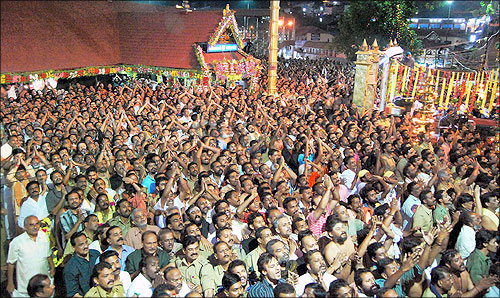
In India, we are proud to have a woman as our President, lady Chief Ministers and quite a few women ministers, they might not have left any stone unturned in ruling the country or the state with utmost efficiency and dexterity. Yet in their own country that too in the 21st century they should not at all be surprised if they are labelled as ‘impure’ and denied entry into the temple called "Sabarimala" which houses a bachelor God called Ayyappa. It is situated atop a hill in Kerala, a state with highest number of literates. Kerala's high court, the highest quarters of justice in the state, not for a moment hesitated in upholding the ban in 1990 blatantly flouting the provisions given in the constitution.
More than fifty years back, when the Constitution of India was framed, "Untouchables" - the lower-caste Indians, who were believed to be "impure" and hence objectionable to God – ‘won’ the right to equality when the gates of temples were ‘instructed’ to be open that earlier remained closed to them. Article 25(2b) was instituted specifically for them; to ensure that they could pursue their religion unhampered. This article gives State the power to make laws for "the throwing open of Hindu religious institutions of a public character to all classes and sections of Hindus" But it seems ‘free’ India is still struggling in its half hearted effort to give ‘the lesser half of men’ permission to enter into the temples along with the dalits.
The ban has once again triggered the debate of whether women are considered as equal citizens of India or not, by the honourable High court. It also raises a pertinent question in today’s so called modern society whether Constitutional provisions are superior or some of the outdated customs? It has also brought forth the issue that in a democracy, is purity the essential criteria for its effective functioning or responsible citizenship? If purity is placed at the top in the priority list, then who is considered to be a pure person and who is impure? On what grounds purity of a person is going to be proved? Is it someone who denies basic right to health and even right to life to his fellow citizen by supplying dangerous concoction in the name of ‘milk’ made by mixing urea, detergents and other chemicals, or someone who distributes contaminated ‘parshad’ outside the religious places or a person who doesn’t hesitate to commit rape of even a small child or a murder even, or someone who misuses his skills for few chunks of money, in depriving someone of his vital organs? A negligent hospital staff, responsible for the death of newborn babies? A negligent train or bus staff responsible for killing innocent commuters? Tortourous murderer in-laws ? Are all these people going to be allowed entry into the holy premises of Lord Ayyappa except for women who fortunately or unfortunately ‘mothers’ a man?
On 19th December 2011 a purification ceremony was being performed at the Lord Ayyappa temple after a 35-year-old woman entered the shrine and offered worship in violation of the custom barring entry of girls and women in the 10-50 age group. According to the temple administration officials the ceremony was performed at the 18 sacred steps (pathinettam padi) leading to the main temple, and near the sanctum sanctorum. Temple tantri (traditional high priest) led the purification ceremony according to the Travancore Devaswom Board officials. The woman, identified as Saraswathi from Andhra Pradesh, managed to climb the highly-revered 18 steps, entered the temple complex and offered worship in the afternoon. She was spotted by Rapid Action Force personnel while she was near Mallikapuram, sub-temple in the complex.RAF personnel handed her over to the local police, who, however, let her go and did not register any case. In an another incident a mother of two ill children wanted to enter the temple; and she was arrested before reaching the sanctum and this ban was upheld by the Kerala High Court in 1990. In December 2002, a bunch of women supposedly tried to enter the shrine. And the Kerala HC ordered a probe to see how that happened ! A similar controversy had broken out in 2006 after Kannada actor of yesteryear Jayamala claimed to have entered the temple during her prime and touched the idol of the presiding deity, claiming that she was pushed into the sanctum sanctorum by the surging crowd.
A case was registered against Jayamala and a charge sheet was filed in a court last year against her in connection with her claim but it was stayed by the Kerala High Court last October. There is no denial of the fact that gender discrimination still exists in Indian society which is still conspicuosly experienced in the temples. There is a long list of lame reasons given, amusingly, one being that of impurity related to menstruation, a phenomenon which is biologically controlled, unfortunately is regarded as a disability and ban is imposed on that ground to enter the temple.
As far as our knowledge of biology goes, without certain “biological processes” it would have been difficult for women to produce even a man. Nature recognizes and bestows equal importance to both men and women in bringing into the world their progeny, but it is the Man who considers his sole privilege to discriminate. It’s a great paradox that once the man is out of the women’s body he misses no opportunity to flaunt that he is superior to women and makes sure she too believes in his superiority. He cleverly denies her the right to education and writes down all laws suiting his interests. She is made to feel ‘unsafe’ without him, repeated assaults on her integrity confirms her doubt. The same “natural processes” which earns her the honor of being called fertile and ‘useful’ enough to produce sons for man, becomes a disqualification in her efforts to enter the temple. A harmless menstruating lot of women are considered far more dangerous than the country’s worst lot of criminals and terrorists. The question arises, it is said that when not a leaf moves without the will of the Lord then why should He create and then deny an opportunity to get His “darshan” to some of His blind devotees?
That makes it easier to understand that why corruption still flourishes in our country, norms of purity related to caste, gender etc., are so deeply ingrained in the minds of the people, that nobody really bothers about the constitutional laws or notion of owing any kind of moral responsibility towards the society let alone the country.
“In free India, women still seem to be in chains everywhere”. She is unnecessarily burdened with the guilt of disturbing the peace of mind of the greatest of all gods let alone men. The promiscuous qualities of most men goes unquestioned and it is the women who has to solely live with the guilt of provoking men into victimizing their lot. For the same reason, few months back there was a furore over girls wearing jeans, which covers her body respectably and comfortably more than the traditional Indian sarees which renders the body half naked. If apparels were to be blamed then why is it that the incidents of rape and molestation in the villages are on a rise? That too mostly the victims are poorly clad ‘untouchable’ dalit women who are either caught on their way to work or on their way to the fields to answer the nature calls, under tens and above 70 are also not spared. The ill-fed domestic help in the cities are also considered a great source of ‘provocation’ for the elite of the elites. The sellers of fairness creams and other branded expensive cosmetic items need to pull their shutters down!
But what perplexes the mind is neither the honourable court of justice nor a temple considers a rapist or a child molester ‘impure’ or creates a fuss over his entry into the temple. But a woman who serves man from day to night sometimes as a mother in his childhood and wife in later years, fasts for his long life day in and day out has to be pulled away from the temple premises by a couple of policemen like a ‘criminal’ for exhibiting her ‘extra devotion’ to the Lord.

The purity and impurity question needs to be reconsidered on priority basis even before we deal with the issue of corruption. In 21st century to make democracy more fruitful and effective, Indians are in dire need of a training in character building and honest handling of responsibilities. This will not happen unless we learn to accept India as one country and other citizens as our brethren and sisters. Since ages ‘pluralities’ have enriched our culture and we have been living with such uniqueness knowingly or unknowingly. There’s a deliberate and a dire need to preserve that tradition, not tear it apart in a naïve bid to prove ones superiority over the other. No longer there exists a dividing ‘Raj’ then why are Indians still toddling in their efforts to see India build as a strong nation? Napoleon Bonaparte once said “Give me good mothers and I will give you a good nation” But it is to be remembered, ‘goodness’ of mothers depend on her good mental and physical being and unless she is given equal rights as a citizen and right to live peacefully, a country will neither progress nor emerge as a strong nation!
Dr.Shura Darapuri Coordinator, Centre for the study of Social Exclusion and Inclusive Policy, Baba Saheb Bhim Rao Ambedkar University, Lucknow (U.P.), India

Israel Killed 180 Palestinians, Including 21 Children, in 2011

Israel Killed 180 Palestinians, Including 21 Children, in 2011
By Middle East Monitor

30 December, 2011
Middleeastmonitor.org.uk
The State of Israel killed 180 Palestinians in 2011, including 21 children. These shocking figures were given in a report issued by the Palestinian Liberation Organisation entitled, "A People under Occupation". The year also saw 3,300 Palestinians in the West Bank and Jerusalem detained by the Israeli occupation authorities.
The PLO report noted that in 2011 alone the government of the Zionist state approved the construction of another 26,837 settlement units across the Occupied Palestinian Territories, including 1,664 housing units in and around Occupied Jerusalem; almost 4,000 acres of land belonging to Palestinians have been confiscated by Israel; 495 houses have been demolished; and 18,764 olive and fruit trees have been uprooted.
With regards to Jerusalem, the report records that the establishment of the Shu'fat military checkpoint by the Israelis, which separates Jerusalem from the Shu'fat refugee camp, has resulted in the isolation of more than 60,000 Palestinians living in the camp and the areas around it. This is part of what the compilers of the report confirm is Israel's Judaisation policy, as was the closure of the Magharba Gate Bridge which leads to Al Aqsa Mosque.
Illegal Jewish settlers, claims the PLO report, have committed a series of "terrorist" attacks on mosques throughout 2011, which escalated in December with arson attacks on the Okasha Mosque in West Jerusalem, the Nour Mosque in the village of Burqa in Ramallah, and the Ali Ibn Abi Talib Mosque in the village of Bruqin village in Salfit. Settlers also, the report notes, wrote racist slogans on the Sahaba Mosque in Bani Naim in Hebron and violated the sanctity of the St. John the Baptist Orthodox Church near the River Jordan.
Also in December, Jewish settlers set fire to at least 12 Palestinian vehicles across the occupied West Bank and confiscated around 500 acres of Palestinian land to expand their illegal settlements near Jenin and Bethlehem.

US Menaces Iran Over Strait of Hormuz

US Menaces Iran Over Strait of Hormuz
By Peter Symonds
30 December, 2011
WSWS.org
The Obama administration has issued what amounts to a threat of war against Iran following comments by senior Iranian officials that Tehran would close the Strait of Hormuz in response to an embargo on its oil exports. To reinforce the point, the US navy sent two of its warships—the aircraft carrier USS John C. Stennis and the guided-missile destroyer USS Mobile Bay—on a “routine transit” through the strategic waterway where the Iranian navy is currently holding exercises.
The growing tensions in the Persian Gulf are the result of provocative steps by the US and its European allies towards blocking Iranian oil exports. President Obama is about to sign a measure into law that would freeze the US assets of foreign financial institutions doing business with Iran’s central bank—moves that would seriously impede Iranian oil exports. At the same time, Britain and France are pressing the European Union to adopt an embargo on the import of Iranian oil.
Any restriction on Iran’s energy exports would seriously damage the country’s economy, which is already under pressure from previous sanctions imposed both unilaterally by the US and its allies and by the UN Security Council.
The value of the Iranian currency has fallen by about 20 percent against the US dollar in the past few months. Last week, the US Treasury Department continued to tighten the economic noose around Iran by blacklisting 10 companies in Malta accused of acting as fronts for the Islamic Republic of Iran Shipping Lines.
Confronting potential economic chaos, Iranian vice president Mohammad-Reza Rahimi warned on Tuesday: “If they impose sanctions on Iran’s oil exports, then even one drop of oil cannot flow from the Strait of Hormuz.” The US Defense Department and the Navy’s Fifth Fleet, which is based in the Gulf State of Bahrain, both issued statements warning that any step to inhibit “freedom of navigation” through the waterway would “not be tolerated”—a tacit threat of military action.
The US and international media immediately seized on Rahimi’s remarks to paint Iran as the belligerent power. However, it is the Obama administration that has been deliberately heightening tensions with Iran, setting the stage for a possible military confrontation. The threatened oil embargo is itself an act of aggression—a point that is uniformly ignored in the compliant American press.
The move towards oil sanctions takes place in the context of nearly a decade of US military threats against Iran over unsubstantiated claims that it seeks to build nuclear weapons. Moreover, it is all but openly acknowledged that Israel and the US have over the past two years been engaged in acts of sabotage directed at Iran’s nuclear program and its military—including the use of computer viruses, explosions at key facilities and the murder of nuclear scientists.
Over the past month, the Obama administration has taken a markedly more aggressive stance. Using an International Atomic Energy Agency (IAEA) report published in November as the pretext, the White House has pushed for tougher international sanctions against Iran and emphasized that all options—including military strikes—would be used to prevent Tehran from building nuclear weapons.
The IAEA report was in every way a political document. Produced under pressure from Washington, it contained a key appendix arguing that Iran had carried out research related to nuclear weapons. Most of the activities ended almost a decade ago. Some of the “evidence” has been challenged by Iran as having been fabricated by Israeli or US intelligence agencies—an issue passed over by the IAEA.
US Defense Secretary Leon Panetta upped the ante last week by declaring in a CBS interview that Iran could have a nuclear weapon within a year or “perhaps a little less”—if there was a hidden uranium enrichment facility somewhere inside Iran. He offered no evidence either that Iran had such a plant or was building a bomb. But that did not stop Panetta from declaring that acquiring a nuclear weapon would be a “red line” for the US, which would “take whatever steps necessary to deal with it.”
As if to spell out what Panetta meant, US Joint Chief of Staff chairman General Martin Dempsey told the media the following day that the Pentagon had drawn up military options that were reaching the point of being “executable if necessary”. He warned Iran against underestimating US resolve, saying: “Any miscalculation could mean that we are drawn into conflict and that would be a tragedy for the region and the world.”
Behind the scenes there is clearly an intense debate taking place in Washington over a US military attack on Iran. A Wall Street Journal editorial yesterday urged the White House to declare that it would consider any restriction on oil tanker traffic through the Strait of Hormuz as an act of war warranting a military response. “That response would be robust and immediate, and it would target Iran’s military and nuclear assets, perhaps even its regime,” the newspaper declared.
A detailed article by security analyst Eli Lake in the Daily Beast on Wednesday pointed to intense discussions between the US and Israel in recent weeks over the prerequisites for a military attack. In the context of a well-publicized debate in Israel over military strikes, Lake noted that the White House had been “reassuring the Israelis that the administration had its own ‘red lines’ that would trigger military action against Iran, and that there is no need for Jerusalem to act unilaterally.”
In addition, an essay entitled “Time to Attack Iran” has just been published in Foreign Affairs, the premier journal of the American foreign policy establishment, calling for the US to take military action now. In answering critics, it argued that “a carefully managed US attack” could destroy Iran’s nuclear facilities without provoking an all-out war that threatened to engulf the region. Significantly, the author of this plan for military aggression is Matthew Kroenig, who was until July a special advisor to the Office of the US Secretary of Defense, responsible for Iran.
While Kroenig and other advocates of war focus on the purported danger of Iranian nuclear weapons, the real purpose of any military action is to advance longstanding US ambitions for regime change in Tehran as part of broader aims for domination of the energy-rich regions of the Middle East and Central Asia. Washington’s latest menacing moves take place as the US seeks to exploit the oppositional movements throughout the regions—most recently in Syria—to install regimes more amenable to American interests.
US efforts to ensure regional hegemony are above all aimed at its rivals, chiefly China, which is heavily dependent on Middle Eastern oil imports including from Iran. It is precisely this intersection of any conflict over Iran with wider geopolitical rivalries that heightens the risk of a local war in the Persian Gulf becoming an international catastrophe.
http://www.countercurrents.org/symonds301211.htm

The Political-Military-Academic Construct

Dirty work & ‘good people’
The Political-Military-Academic Construct
robi chakravorti
IN his farewell address many years ago, the US President Eisenhower emphasised the linkage between the military and industrial complex. He also hinted at the potentiality of the operation of the military-industrial complex in the political-academic segment. A free and critical university, he noted in his address, as the “fountainhead of free ideas and scientific discovery, has experienced a revolution in the conduct of research... A governmental contract becomes virtually a substitute for institutional curiosity.”
Government funding to academic institutions has increased a great deal since. The CIA has provided funds, directly or through academic institutions, to influence intellectual activities such as research, publications or conventions.
In 1985 a scandal was reported over a conference on Islamic fundamentalism held at Harvard University. The director of Harvard’s Center for Middle Eastern Studies, who organised the conference admitted receiving a CIA grant of $ 45,000 for the meeting. Earlier, he had received over $100,000 from the CIA for working on a book on Saudi Arabia which was duly published by Harvard University Press
A report published in the New York Times (13 December 2008) revealed that Harvard University received a donation of $20 million from a prince of the Saudi royal family to finance Islamic studies. Saudi Arabia is also economically and militarily supported by Washington. It can be called a US satellite ally in the Middle East. These are instances of a linkage between politics, money and academia. Let me present two cases of direct, open relationship within the military-academic complex.
An article published in The Times, London, (28 March 2006) was titled, “How Oxford has taught America a new way to fight battles”. The article reports how an American military officer, Colonel Nagi who was a Rhodes scholar at Oxford and a senior Pentagon adviser, wrote a thesis on how the British army succeeded in snuffing out the Malayan insurgency between 1948 and 1960. The book is reported to have impressed the US commander in Iraq. The writer of the thesis, once interviewed, quoted an interesting comment by the 19th century British soldier, Sir William Francis Butler: “A nation that draws a demarcation between its thinking men and fighting men will soon have its thinking done by cowards and its fighting done by fools.”
The Footnotes Bulletin (July-August 2005) of the American Sociological Association published a report entitled: “Sociological Skills Used in the Capture of Saddam Hussein.” An American military officer, who wrote the piece, combined official military experience with the sociologist’s status as a PhD student. The University of Maryland, where he was a sociology student, also had an institution called Center for Research on Military Organisations. It advocated sociological training for military officers. The officer, Major Brian Reed, was stationed in Iraq from March 2003 to March 2004. He claimed that a scholarly analysis of the social network of the area, where Saddam Hussein lived, facilitated the strategy that led to his capture. According to his statement in the Footnotes Bulletin, “We constructed an elaborate product that traced the tribal and family linkages of Saddam Hussein thereby allowing us to focus on certain individuals who may have had (or presently had) close ties with him.”
Military sociology courses are offered at West Point, Air Force Academy and the Naval Academy. The Center for Research on Military Operations received $1.1 million for research on “Social Structure, Social Systems and Social Networks.” According to the University of Maryland’s military sociologist and director of the Center for Research on Military Organisations, there are an estimated 700 military sociologists the world over.
The political-academic complex can assume a different form and may win support both from politicians and academics. In March 2006, the Footnotes Bulletin published a report, claiming that public sociology helped the US police control illegal immigration of cheap labour from Mexico.
A report by a sociology professor who worked with the US Border Patrol claimed that he collected data on the US-Mexico border immigration problems and sent them to the US Congress. He was sympathetic towards the plight of thousands of undocumented workers who were apprehended and several hundreds who died every year while trying to enter the US as cheap labour.
One can describe this as a liberal form of the political-academic complex. This is different from covert and overt connections between the military-political-academic complex which can be described as “dirty work” with the help of “good people”. A classic example was the operation of the Heritage Foundation. According to a report in the mid-eighties, Heritage Foundation was used as a conduit for transferring private contributions to Contra rebels in Central America. It formed an Asian Studies Center organising conservative, pro-US think-tanks in South-east Asia.
There are many private organisations that work in collusion with the government’s foreign service agencies. According to a report in the New York Times (5 November 2005) a former CIA agent once said: “Hide spies posing as cultural or economic attache’s in embassy-based CIA status. CIA’s secret training center runs a 6-month course to train spies for such positions ... students, executives can act as CIA spies.”
In many cases, this kind of linkage may cross the thin line between informed give-and-take and improper work like espionage and militant intervention. A book published in 1999 ~ Who Paid The Piper? CIA and the Cultural Cold War ~ referred to many high-level institutions established during the Cold War.  A report presented in the book, Professors, Politics and Pop (1991) alleged that Yale University had links with the CIA for decades.
According to reports based on The Mitrokhin Archive 11: The KGB and the World (Penguin), the KGB also worked in the same style during its money-laundering operations in India at the height of the Cold War. With the decline of Soviet power, the CIA operates to a degree unmatched by any other country. America has one advantage for this kind of activity which other countries lack. As a nation of immigrants, it can use many Trojan Horses from the immigrant population for such operations.
There was a weird case of the CIA-academic linkage during the Cold War. This was described as cultural propaganda that advocated a “liberal” approach in contrast to Communist methods. During the heyday of Soviet power, vast resources were expended on secret programmes for what can be called cultural propaganda, especially in Europe. These programmes were secretly funded and run by the CIA. The major institution was the Congress for Cultural Freedom. It had offices in many countries, published several prestigious magazines, organised international conferences, held art exhibitions and rewarded musicians and artistes with prizes and public performances. The Congress for Cultural Freedom’s most famous product was Encounter magazine. It was a very sophisticated journal that was published till 1970. Its writers included WH Auden, Evelyn Waugh, Stephen Spender, and Isaiah Berlin. The articles influenced liberal Western culture, as opposed to the Communist one. It never published any critique of America. The  Congress for Cultural Freedom propagated freedoms, except the freedom to criticise America. The agency sponsored similar publications in France, Germany and Italy. When the source of funding of Encounter was revealed, its co-editor Stephen Spender resigned. The magazine’s American co-editor, Irving Kristol, a professor of New York University, when aware of the CIA funding openly supported it saying, “I think it is interesting that the only British magazine worth reading at the time was funded by the CIA and the British should be damn grateful.” This is an example of sophisticated avenues of sponsoring support of ideological aspects of US policy in a selective manner.
The writer is former Professor of Sociology, California State University at Sacramento