Pages

Free counters!
FollowLike Share It

Sunday, 23 October 2011

#OWS: Let Me Tell You Wall Street Asshats a Little Something About Hippies


#OWS: Let Me Tell You Wall Street Asshats a Little Something About Hippies

Wed Oct 19, 2011 at 10:32 AM PDT
One of the attack memes for right wingers and know nothings is that the Occupy Wall Street movement is merely the wacky doings of hippies, or aging hippies, or dirty fucking hippies.
Now I don't want to make this all about hippies...because it isn't. The #OWS movement is a phenomenon all to itself. Blaming it on hippies is just typical weasel behavior from the champaigne-sippin', caviar-dippin' greedheads of Wall Street crowd – you know, the ones who got us into this mess in the first place. It's just their way of avoiding responsibility, and boy howdy are they good at it.
But hippies, young and old, are involved...and that's a damned good thing.
Let me tell you something about hippies. Hippies didn't export anyone's jobs, hippies didn't lie us into an immoral war, hippies didn't  conspire to steal anyone's pension funds, hippies didn't order anyone tortured, hippies didn't steal so much that it crashed the economy of the entire world, and hippies don't go on national tv and spew nonsense and propaganda for a very nice living.
So go ahead and blame hippies for everything...as if they had ruled us for decades. We should be so lucky. But we weren't that lucky - not by a long shot. Instead, we got you.
So if the hippies have some advice for you Wall Street assholes, maybe you should listen. You could do worse. You did do worse. You did a lot worse.
Hippies told you to mind your planet. Hippies told you to make love not war. Hippies told you to not let greed grab you. But did you listen?
No. You and your minions in Congress and elsewhere turned your backs on responsibility. You abandoned the people and sold your souls to the highest bidders. Consequences be damned.
You should thank what gods may be that there are still hippies, that there are still people who put humanity over corporate profits, that there are still those who insist that we do the right thing rather than the profitable thing. We just may save the planet from assholes like you.
Meanwhile, our bought-and-paid-for politicians can't do shit:
Global warming? Sorry.
Unjust wars? Nope, nothing to be done.
An oppressive and unjust Military Industrial Complex? C'est la vie.
Class warfare by the 1% against the 99%? It's only class warfare when we say it is.
The disastrous drug war? Whatcha gonna do?
Loss of precious civil rights? Quit yer bitchin'.
Mercenaries on the streets of America? What's to worry about?
Corporate takeover of the country? Yawn.
No, our bought-and-paid-for politicians can't do anything that doesn't involve shoveling cash into the coffers of the already filthy-fucking-rich. And by their inaction they would doom us all.
You greed-deranged fools who have done these things to us had better hope that the dirty fucking hippies come riding to the rescue. Otherwise we are all going to suffer a fate that only you deserve.
I don't care what anyone says, there is something sweet and pure about old hippies like Ben Masel and others. People who still retain their principles and ideals and are still willing to stand up for humanity in the face of unrelenting tyranny. They deserve respect not scorn. Bless them all.
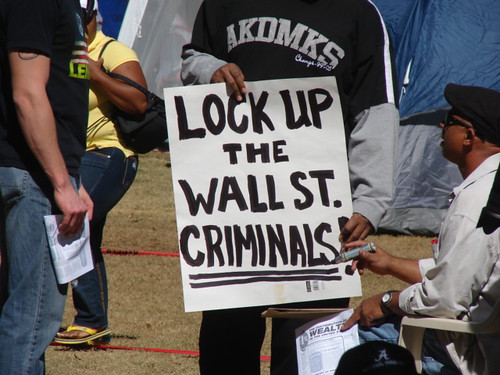
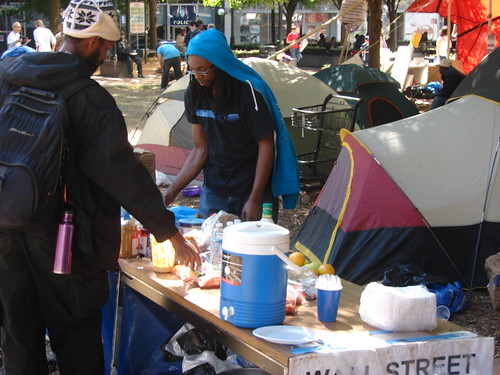
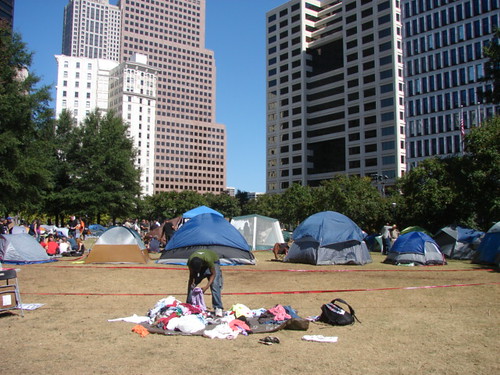
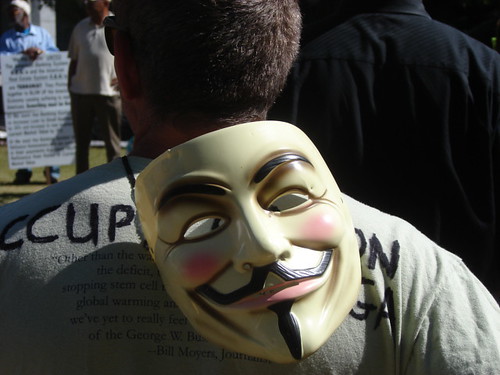
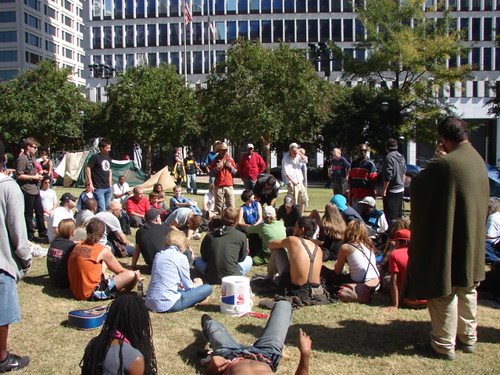
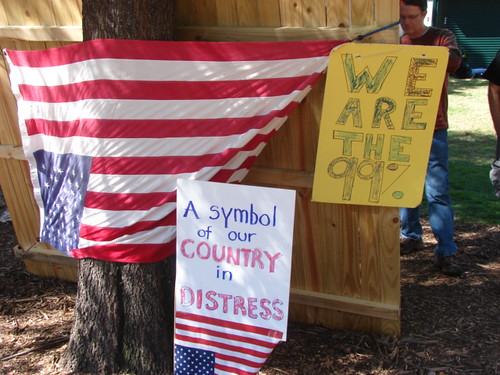
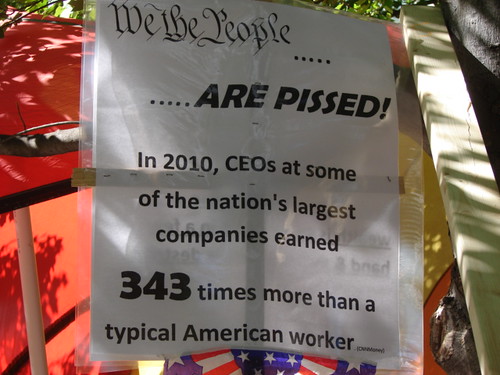
The following photos are from the October 15th Day of Global Action in Troy Davis Park, Atlanta, Georgia.
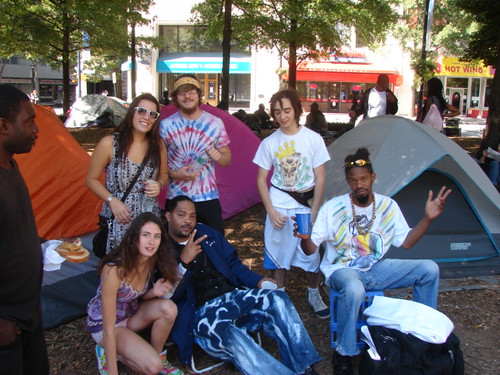
Occupy ATL 2 062
Occupy ATL 2 109
Occupy ATL 2 008
Occupy ATL 2 012
Occupy ATL 2 103
Occupy ATL 2 092
Occupy ATL 2 022
Occupy ATL 2 108
Power-to-the-People-Peace-Out-OPOL

Sectarian Violence Escalates in Balochistan as Shi'a Holy Month Approaches

Sectarian Violence Escalates in Balochistan as Shi'a Holy Month Approaches
Publication: Terrorism Monitor Volume: 9 Issue: 38
October 21, 2011 11:43 AM 
By: Derek Henry Flood
http://www.jamestown.org/programs/gta/single/?tx_ttnews[tt_news]=38553&tx_ttnews[backPid]=26&cHash=4c7b16879389d0913f949bee1255258a

Recent incidents in which dozens of Shi'a Hazaras have been killed by Sunni militants have put Balochistan's religious minority on a knife's edge. On October 4, a bus ferrying Shi'a men to work at a vegetable market on the outskirts of Quetta was assaulted by unidentified motorcycle-borne gunmen. The attackers dragged 13 men off the bus, lined them up and sprayed them with Kalashnikov fire (AP, October 4). On September 23, three Hazara men going to work at a coal mine outside Quetta were murdered after their van was stopped by Sunni extremists (Express Tribune [Karachi], September 24).

On September 20, a group of Shi'a pilgrims were traveling to Taftan, the lone official border crossing with Iran, when they had their bus boarded near the town of Mastung by Sunni Deobandi militants who forced 26 male passengers off the coach whom they identified as Shi'a (Samaa TV, September 20). The captives were then shot execution style on the roadside in front of their families. Notably, in December 2010, militants attempted to assassinate Balochistan's top politician, Chief Minister Nawab Aslam Raisani, because of his pledge to protect Shi'a civilians in his jurisdiction (AFP, December 7, 2010). A suicide bomber approached Raisani's convoy in Quetta, killing one and injuring nine, though the Chief Minister escaped unscathed. 

Balochistan, Pakistan's largest province by area - at 43 percent of its total land area, has a proportionally tiny population when compared to eastern Pakistan and is vastly underdeveloped despite the region's immense natural resources. Balochistan is ethnically divided along rough north-south lines, with Baluchis running from the center on south to the ancient coastal trading ports of Makran on the Arabian Sea. The coastal region includes the former fishing village of Gwadar, recently redeveloped into a major deep-sea port with Chinese funding. The province's northern reaches hugging the southern Afghan provinces of Nimroz, Helmand, Kandahar and Zabul are populated by Sunni Pashtuns.

Balochistan hosts insurgents active in both Iran and Afghanistan while being torn apart internally by both ethno-nationalist and sectarian militancy. The province has been plagued with a multitude of complex security problems since Pakistan's founding in 1947. These challenges have only worsened since the American war in Afghanistan began a decade ago. Though anti-Hazara violence predates the 2001 American invasion and occupation of Afghanistan by several years, incidents of violence continue as Taliban factions and their Sunni chauvinist allies in Pakistan accuse the Hazara of collaborating with Western militaries since the Mullah Mohammed Omar-led emirate was deposed ten years ago.

The Hazara community of Quetta, Balochistan's provincial capital, migrated from the Hazarajat region in central Afghanistan when Afghan Amir Abdul Rahman declared jihad on their ethno-religious community at the end of the nineteenth century. This exodus forced them to seek protection from the colonial administrators of the British Raj who ruled what is today Pakistan. Almost exactly a hundred years on, the Afghan Taliban carried out a campaign against the Hazaras as they consolidated their rule over Afghanistan that many international human rights campaigners labeled ethnic cleansing. As Persian speaking Shi'a with origins in Central Asia, a radical fringe of Pakistani Sunni religious polemicists view them with perpetual disdain.

Regular attacks on Hazaras in Balochistan began in the late 1990s in the wake of an urban sectarian war between Sipah-e-Sahaba Pakistan (SSP) and Sipah-e-Mohammad Pakistan (SMP). These groups were supported by Saudi and Iranian state patrons respectively in the context of a religious proxy conflict on Pakistani soil. Lashkar-e-Jhangvi (LeJ), an ever-more radical Sunni movement that splintered from the SSP, continues to carry out mass attacks on Shi'a. The unabated spate of anti-Hazara violence may very well be linked to the presence in Quetta of the Afghan Taliban leadership, the Quetta Shura. 

When the Taliban were at war with the Hazara Hizb-e-Wahdat during the fall of Mazar-e-Sharif in August 1998, Pakistani sectarian groups fought alongside the Taliban. The agendas between the two movements blended to a degree as the Taliban adopted an anti-Shi'a bent and LeJ took on some broader jihadi themes in its sectarianism.

When Mazar-e-Sharif ultimately fell to Taliban forces, large-scale reprisal killings were carried out against Hazara civilians trapped inside the city. [2] Since the city fell to Hizb-e-Wahdat, the ethnic-Uzbek Junbish-e-Melli militia of Rashid Dostum and the ethnic-Tajik Jamiat-e-Islami forces of Marshal Mohammed Fahim (with the backing of American Special Forces) in November 2001, the Taliban's contempt for the Hazara has yet to ebb. Hazara fighters fought aggressively against a Taliban prisoner uprising at the fort of Qala-e-Jangi north of Mazar-e-Sharif following the city's fall. With the ouster of the Taliban, many Pakistani Sunni jihadis returned to Pakistan, where some are believed to be behind the current wave of violence Hazara activists are calling genocide.

Attacks on Quetta's Hazara minority began in 1997 with virtually all attributed to LeJ. LeJ ideology employs the inherently controversial concept of takfir whereby they grant themselves the authority of declaring other Muslims apostates worthy of death. LeJ recently distributed a letter in Quetta essentially declaring war on the Hazara: "All Shiites are worthy of killing. We will rid Pakistan of unclean people. Pakistan means land of the pure and the Shiites have no right to live in this country We have the edict and signatures of revered scholars declaring Shi'ites infidels. Just as our fighters have waged a successful jihad against the Shiite Hazaras in Afghanistan, our mission in Pakistan is the abolition of this impure sect and its followers from every city, every village and every nook and corner of Pakistan" (Asia Times Online, October 5).

Balochistan's highest ranking policeman, Inspector General Tariq Khosa, laid the blame for the sectarian violence on weak-willed politicians who have allowed rural tracts of the province to be guarded by militias called the Balochistan Levies Force who are accountable for their district's own law and order. This arrangement leaves many areas off limits to formal Pakistani law enforcement responsible to Islamabad.

These tribal militias were originally raised by British colonial administrator Robert Grove Sandeman in the late 19th century in order to co-opt restive tribesmen rather than attempt to impose order on Baloch culture from the top down (Baloch Hal, June 24, 2010). After years of "police rule," the century old militia system—having been dissolved by the regime of Pervez Musharraf—was restored by popular demand in April 2010 by the Balochistan Provincial Assembly (Associated Press of Pakistan, April 6, 2010; for Pakistan's tribal levies, see Terrorism Monitor Briefs, February 26, 2010).

Some have challenged the idea of provincial responsibility for Balochistan's security, suggesting it might be better to place it in the hands of Pakistan's Inter-Services Intelligence (ISI) and the Pakistan Army rather than the Balochistan Levies or local and federal police structures.

With the ISI busy countering the machinations of their Indian rivals in neighboring Afghanistan and the Pakistan Army in conflict with groups like the Balochistan Liberation Army, it seems that violence directed at Balochistan's Shi'a minority by the LeJ is simply a low security priority for Islamabad in light of the central government's well defined intelligence and military footprint in the province.

Pakistan's security priority is the Baluchi nationalists fighting for a separate state - whom they accuse of being backed by Indian intelligence - rather than sectarian jihadis repeatedly murdering an underrepresented minority (Indo-Asian News Service, September 5, 2006; Daily Outlook Afghanistan, October 8). President Asif Ali Zardari asked the Hazara community to remain steadfast in the face of such slaughters, pledging to provide protection for Hazara pilgrims en route to Shi'a holy sites in Iran, though he outlined nothing more specific in terms of security for the Hazara (Frontier Post, October 14). When Interior Minister Rehman Malik chaired a meeting that called for Iran-bound pilgrims to be protected by the Pakistani state, Inspector General Khosa responded by stating such protective measures were already in place, though many Hazaras might be skeptical of such an assertion (Express Tribune, October 6).

At the end of November the Shi'a holy month of Muharram will be observed in Quetta by the city's estimated 400,000 Hazaras. With their high visibility, public Ashura processions (marking the martyrdom of Husayn ibn Ali in 680 CE) will be vulnerable to LeJ suicide bombers. So long as Malik Ishaq, the group's leader, and the LeJ leader in Balochistan, Usman Saifullah Kurd, remain at large, the security of Hazaras in the province will continue to deteriorate (News International, October 7; see Militant Leadership Monitor, July 2011).

Notes:

1. Ravi Shekhar Narain Singh Singh, The Military Factor in Pakistan, New Delhi, 2009, p.386.

2. The Taliban killings of Hazara inside Mazar-e-Sharif in August 1998 were reprisals for the execution of hundreds, perhaps thousands, of Taliban fighters in May 1997 when Taliban forces and their foreign jihadi allies tried and failed to capture the city. See Human Rights Watch, "Backgrounder on Afghanistan: History of the War, The Third Phase: The Taliban's Conquest of Afghanistan, October 2001," www.hrw.org/legacy/backgrounder/asia/afghan-bck1023.htm.

Perspectives on the Islamist and Salafist Parties in Egypt: Similarities and Dissimilarities

Perspectives on the Islamist and Salafist Parties in Egypt: Similarities and Dissimilarities
Publication: Terrorism Monitor Volume: 9 Issue: 38
October 21, 2011 11:30 AM 
By: Hani Nasira
http://www.jamestown.org/programs/gta/single/?tx_ttnews[tt_news]=38552&tx_ttnews[backPid]=26&cHash=64e7ec0a2e4485f2c6e8d981d243f014

As part of the growing political process that opened up after the fall of Egyptian President Hosni Mubarak, there are now fourteen Islamist parties in Egypt, a dramatic change from less than a year ago, when all such parties were banned. These religious parties mushroomed after some were approved by the Committee of Political Parties and others after a decision was passed by the Administrative Court endorsing their establishment. [1]

Without a clear cut separation between the religious and the political, the Islamic movement in Egypt has recently tended towards political factionalism. Accusations and counter accusations have become common between various groups; the Fadhila Party, for instance, accused the Assla Party Chairman, Major General Adel Abdul Maqsood, of stealing 3500 records of party members when he left the party and adding them to the members' list of his own party. This accusation was rejected by Abdul Maqsood, saying the remaining Fadhila members are the ones who abandoned the party when they tried to hijack the party by merging it with non � Salafist parties to form a single political front. [2]

Many other Islamist parties withdrew from the Democratic Alliance (al-Tahalof al-Dimqurati) led by the Muslim Brotherhood's new political formation, al-Hurriyya wa al-'Adala (the Freedom and Justice Party) when it became clear the Brothers wanted to monopolize the election lists for the Egyptian parliamentary elections scheduled for November 28, 2011 and the Shura Council election on January 22, 2012. The Nour Party withdrew from the group due to what is perceived as the alliance's support of secularism.

The Salafist groups largely declared their opposition to the Egyptian Revolution, though some Brotherhood youths participated in the Revolution's leadership. In spite of the fact Gama'a al-Islamiya (GI) distanced itself from the Revolution and did not attribute any of its struggles or achievements to itself, the Salafist groups have been among those most ready to exploit Egypt's post-revolution politics and the least flexible in the face of what is sees as policies contradicting Salafist objectives, such as reevaluations of concepts such as citizenship and nationality. The Salafists have also accused the Revolutionary youth of being fanatics or even traitors.

The Salafist stand on the Coptic issue became evident in a series of violent incidents following the Revolution,

* On March 4, the Two Martyrs Church in the Giza Province village of Soul was torched by a Muslim mob. Local Copts remain angry after prosecutors declined to charge anyone in the attack (Ahram Online, April 13). 

* Violent clashes between Copts and Muslims over another church burning on March 8-9 left at least ten dead and hundreds injured in the Moqattam district of eastern Cairo (Egypt.com News, March 9). 

* In April, Salafists joined the Muslim Brothers in a two-day protest in Qena to oppose the appointment of a Coptic governor, General Emad Shehata Michael (Ahram Online, April 16; al-Masry al-Youm, April 18). 

* In May, Salafists assaulted one church and torched another in a violent sectarian clash provoked by a local Muslim who claimed his Christian wife was being held inside the church after converting to Islam (al-Gomhurriya, May 9). 

The Salafists' insistence on a national Islamic identity after the revolution and their animosity towards religious minorities are a basic and prominent element in the discourse of the Salafist political parties. In the 10,000 word manifesto of the Salafist Nour Party, the terms "non-Muslim" and "citizenship" were each mentioned only once, as was the term "civil state." "Human Rights" was only mentioned within the context of the right to healthcare. "Democracy" was mentioned twice, but only within the context of Islamic terms of reference. [3]

The Salafist al-Asala (Authenticity) Party seems closer in its discourse to Sayid Qutb's political thought than it is to the Salafist line of thought. The party emphasizes that their first principle is governance based on "the divine law (Shari'a) for its people and the enforcement of this law, as well as annulling all the other laws that are in contradictions with that of Allah, and never to accept man-made laws and only embrace the divine laws of Allah" (al-Masry al-Youm, October 16).

The Islamist parties and al-Haya'a al-Shari'a lil Islah are currently seeking to unite the efforts of the Islamists to endorse an Egyptian Islamic constitution.

In spite of all the apparent similarities among all these parties and their agreement to stifle democracy, citizenship and governance, one can notice three basic contradictions common to their manifestoes and practices:

1) The parties have allowed political competition to challenge their common Islamic purpose in establishing an Islamic state in post-revolutionary Egypt. This competition is manifested in elections, political conflict, the formation of alliances against other parties and the accusations and counter-accusations that dominate relations between the Salafist parties.

2) Egypt's Salafist parties have incorporated nationalism into their political platforms, a deviation from usual Salafist practices. Salafist parties have regional and nationalistic ambitions such as forming an Islamic axis with Iran and Turkey to further the establishment of a revived Caliphate, as mentioned in the manifestos of the Bena'a wa'l-Tanmiyya (Building and Development) Party, the party of the al-Gama'a al-Islamiya. [4] Other Salafist parties have issued calls for an Arab unity axis or have issued similar nationalist calls.

3) Once the struggle for constitutional reforms began, the Islamist parties unanimously agreed on opposing and challenging the sectarian parties and civil organizations. To this end they decided to carry out a media and religious battle against them before the elections slated for November. On the other hand the Salafist parties completely identify themselves with the Army and its policies designed to open the political process (Ikhwan Online, October 12). The spiritual mentor of the Salafist school, Yasser Borhami, described the sectarian parties as "cartoon infidels that are not worthy of any alliance" (Elbadl.net, October 8).

The post-Revolution proliferation of Salafist political parties is actually impeding their progress towards establishing an Islamic state in Egypt. Political discord prevents the creation of an effective alliance and the parties' close identification with sectarian street violence is unlikely to enhance their appeal to more moderate Egyptian Muslims.

Notes:

1. Among the Salafist parties to be recognized by the Party Committee in Egypt are al-Amal al-Islami (Islamic Action), al-Hurriyya wa al-'Adala (Freedom and Justice Party) the Wasat (Center) Party, al-Nour Party, Asala al-Salafi and the Bena'a and Tanmiya Party. The latter was approved by the Administrative Court after it was rejected by the Party Committee because its platform is based on religious beliefs. It was not clarified how this party differs from the other previously approved. The Salafi al-Fadhila Party is still waiting to be approved by the Committee, as is the Tawhid al-Arabi (Arab Union), an offshoot of al-Amal al-Islami. Other parties are still preparing their papers to be presented to the Committee include al-Salam and Tanmiya Party (led by some former jihadists), the Egyptian Tayyar Party, al-Wasatiya Party (led by Karam Zuhdi, the former Chairman of the Shura Council of the Jama'a Islamiya Party), the Masr al-Bena'a Party( led by Nidal Hamad) and the Nahda Islamic Party (led by Muhammad Habib, former Deputy Supreme Guide of the Egyptian Muslim Brotherhood and Dr. Ibrahim al-Za'afarani, a former member of the Muslim Brotherhood's Shura Council.

2. http://www.muslm.net/vb/showthread.php?t=443388

3. Hani Nasira: "Islamists Contrasts, A Case of al- Nour Party," al-Hayat, July 3, 2011.

4. For the Bena'a wa'l-Tanmiyya Party manifesto, see http://misralbenaa.com/.

SALAFIST ATTACKS ON SUFI SHRINES IN LIBYA MAY INDICATE PROLONGED SECTARIAN VIOLENCE

SALAFIST ATTACKS ON SUFI SHRINES IN LIBYA MAY INDICATE PROLONGED SECTARIAN VIOLENCE
http://www.jamestown.org/programs/gta/single/?tx_ttnews[tt_news]=38551&tx_ttnews[backPid]=26&cHash=31804d96d37095b8d3670e095b4f3372

A sudden series of attacks on Sufi shrines and tombs in and around the Libyan capital of Tripoli by heavily armed men in uniform has shocked the large Sufi community in Libya and may indicate the development of a pattern of sectarian attacks similar to those against Sufi groups in Iraq, Pakistan, Somalia and elsewhere. Supporters in Tripoli welcomed the attacks, claiming the Sufis were using the shrines to practice "black magic" (AP, October 13).

In Tripoli, the attackers broke into the shrines of Abdul Rahman al-Masri and Salim Abu Sa'if, exhuming and taking away their remains while burning relics and other items found at the shrines. Similar attacks were reported elsewhere in Tripoli and in the nearby town of Janzour. Some of the attackers boasted of having come from Egypt for the purpose of destroying Sufi shrines (AP, October 13). Tripoli's revolutionary military council is currently headed by Benghazi Salafist militia leader Abd al-Hakim Belhadj.

Salafists in general oppose the construction of elaborate tombs for Muslim holy men or their visitation in the hope of securing their intercession through pilgrimage and prayer. The sentiment runs so strongly in the Salafist community that Saudi Wahhabis even once tried to destroy the tomb of the Prophet Muhammad in Medina.

In Somalia, heavily armed al-Shabaab fighters have used hammers and other tools to destroy Sufi shrines and graves while chanting "Allahu Akbar." According to an al-Shabaab official, such operations would continue "until we eradicate the culture of worshiping graves" (AFP, March 26; see Terrorism Monitor Brief, April 2, 2010). Al-Shabaab's anti-Sufi approach led to the foundation of Ahl al-Sunna wa'l-Jama'a (ASJ), a Sufi-dominated militia devoted to the destruction of al-Shabaab's Salafi-Jihadists.

In recent years the ever-mercurial Gaddafi backed away from his regime's anti-Sufi policies (largely directed at the once-powerful Sanussi order) and began to encourage the wider adoption of Sufism by Libyan Muslims as a means of countering the growth of Islamism in centers like Benghazi. To this end Tripoli was the surprising host of the Second World Sufi Conference, held in the Libyan capital last February (Tripoli Post, February 15).

Transitional National Council head Mustafa Abdul Jalil denounced the attacks, describing them as "not on the side of the revolution," while urging a noted religious leader in the rebel ranks, al-Sadiq al-Gheriani, to issue a fatwa condemning such attacks. Al-Gheriani has already said he opposes the construction of such shrines, but does not advocate their forcible removal while the successful rebel forces still lack a unified command (AP, October 13).

In neighboring Egypt there have been reports that Salafists intend to destroy a number of Sufi shrines and mosques, beginning with the mosque housing the tomb of al-Mursi Abu'l-Abbas and continuing with the destruction of 15 other Sufi mosques in Alexandria. Sufis in that city have supplied the Egyptian military with a list of 20 mosques that have already been attacked by Salafists. Street-fights have broken out elsewhere in Egypt as Salafists use the post-Revolution breakdown in law and order to attack Sufi shrines (al-Masry al-Youm, April 12). Sufis in Egypt are reported to be forming self-defense committees.

IRGC COMMANDER DESCRIBES IRANIAN VICTORY OVER KURDISH INSURGENTS

IRGC COMMANDER DESCRIBES IRANIAN VICTORY OVER KURDISH INSURGENTS
http://www.jamestown.org/programs/gta/single/?tx_ttnews[tt_news]=38551&tx_ttnews[backPid]=26&cHash=31804d96d37095b8d3670e095b4f3372

The commander of Iran's Islamic Revolution Guards Corp maintains that it was the Guards' ability to confront Kurdish guerrillas on their own terms that led to an apparent defeat of the Partiya Jiyana Azad a Kurdistane (Party of Free Life of Iranian Kurdistan - PJAK) after a three-month offensive.

Commander of the Islamic Revolution Guards Corps (IRGC) Major General Mohammad Ali Jaffari suggested that PJAK had mistakenly believed that Iranian forces would use "classic warfare" tactics incapable of defeating guerrillas in the field: "The IRGC's capability in both classic and asymmetric and guerrilla warfare surprised the PJAK terrorist group so much that they surrendered� Since the IRGC enjoys asymmetric and guerrilla warfare capability, in addition to its capability in classic wars, the PJAK group was encountered in its own method� and they realized that we have the ability to deploy troops and defeat everyone everywhere" (Fars News Agency, October 8; ISNA, October 8).

Following a series of border incursions by teams of PJAK fighters, Iran deployed a force of 5,000 IRGC troops and Border Guards to largely ethnic-Kurdish northwestern Iran, where they destroyed a PJAK base in the Jasosan Heights near Sar Dasht city in West Azerbaijan Province (Fars News Agency, September 26; see Terrorism Monitor, August 19). The offensive halted for a month following a Ramadan ceasefire negotiated by northern Iraq's Kurdistan Regional Government (KRG), but operations resumed when it became clear PJAK had not used the break to withdraw to their bases in northern Iraq. The IRGC also claimed that PJAK had used the Ramadan ceasefire to dig tunnels in the Jasosan Heights along the border and to receive weapons and equipment supplied by the U.S. Consulate in Arbil (Fars News Agency, October 8).

After a number of battlefield setbacks that included the death of PJAK deputy commander Majid Kavian (a.k.a. Samakou Sarhaldan), PJAK unsuccessfully tried to have the ceasefire renewed, an impossibility so long as PJAK occupied Iranian territory (Sepah News, September 7). KRG president Masoud Barzani, wary of the possible implications of sending Kurds to secure the borders from other Kurds, instead urged both PJAK and their senior partner, the Parti Karkerani Kurdistan (Kurdistan Workers Party - PKK) to come to settlements with their respective Iranian and Turkish opponents (AFP, September 7).

By September 21, the IRGC was claiming to have killed over 180 PJAK fighters while driving the group out of northwestern Iran (Payvand Iran News, September 21). PJAK claimed to have killed 600 Iranian soldiers in its resistance to the Iranian offensive, a figure that has little basis in reality (AFP, September 15). The real figure is more likely in the dozens. Iranian Intelligence Minister Heidar Moslehi said that PJAK had agreed to stay one kilometer away from the Iranian border but promised that Iranian forces would continue taking action against PJAK until the group was destroyed (Mehr News Agency, October 9).

Brigadier General Ali Shademani, Deputy Head of the Operations Department of the Iranian Armed Forces, told Iran's official press that PJAK was a creation of the United States, the United Kingdom and Israel and would be replaced by these nations once it became clear PJAK would not succeed in its objectives (Press TV, September 29). PJAK in turn has accused the United States of providing intelligence about the Kurdish insurgents to Turkey which is then shared with the Iranians, though Ankara has denied passing on U.S. intelligence reports to Tehran (Rudaw.net, September 10).

Some Turkish media sources reported that the effective leader of the PKK, Murat Karayilan, was captured during Iranian operations in mid-August. The Iranians allegedly located the PKK commander by using intelligence provided by Turkey's Milli Istihbarat Teskilati (National Intelligence Organization � MIT). It is widely suspected in Turkey that Iran intervened to save Murat Karayilan from being killed by Turkish bombing by arresting and later releasing the PKK leader (Hurriyet, October 17). In this scenario it has been speculated that the PJAK withdrawal from its forward bases in Iran was the price of Karayilan's freedom (Yeni Safak, October 12; Today's Zaman, October 12; Hurriyet Daily News, October 11). 

Karayilan affirmed that he was not under detention in Iran when he appeared on the PKK-affiliated Roj TV in early October, a declaration Iranian authorities supported by saying they had no information regarding the alleged arrest of Karayilan (Rudaw.net, October 18). Turkish authorities expressed satisfaction with Iran's denials, saying Turks should "turn a blind eye" to the allegations while refuting a rumor that Karayilan had been captured by Syrian forces (Hurriyet October 14). 

Hundreds arrested at Indonesia protest

 
http://edition.cnn.com/2011/10/20/world/asia/indonesia-papua-declaration/
Hundreds arrested at Indonesia protest
By Kathy Quiano, CNN
October 20, 2011 -- Updated 0904 GMT (1704 HKT)
STORY HIGHLIGHTS
a.. NEW: Police say they intervened because the gathering violated the permit 
b.. NEW: Activists say the melee resulted in death; police deny it 
c.. Soldiers swarm in after the Papuan People's Congress read a declaration of independence 
d.. West Papua has long had a low-level insurgency demanding separation
Jakarta, Indonesia (CNN) -- Indonesian security forces arrested about 300 protesters who gathered Wednesday in the eastern province of West Papua to declare independence.

Soldiers swarmed in soon after members of the Papuan Peoples' Congress read their declaration in the provincial capital, Jayapura.

"The reason we broke in was because the Congress violated the permit. The permit was only to talk about the basic rights of Papuans," said Papua police Senior Commissioner Wachyono.

Wachyono, like many in Indonesia, go by one name.

The soldiers fired shots in the air and used batons and canes to disperse the crowd, two prominent Papuan figures said.

Police did not dispute the account, but said the crowd fought back, resulting in about 20 injuries.

Ruben Wagai, a member of Papua's local legislature, said three people were killed. Victor Yeimo, a spokesman for the West Papua National Committee, said at least two died.

Wachyono said there were no fatalities.

About 300 protesters were then taken into custody, but will be released, police said.

"Security forces shouldn't use unnecessary force in quelling a peaceful demonstration," said Elaine Pearson, deputy Asia director at Human Rights Watch.

West Papua and the nearby Papua province has long had a low-level insurgency that demands independence from Indonesia, saying the government is trying to take its land to steal resources.

They have regularly called for a referendum on independence.

"What was read out is nothing new," Yeimo said. "It's been a demand from the Papuans for many decades now".

But, Yeimo added, many at the gathering were unaware that a declaration of independence would be read. He said he didn't agree with it either, preferring to fight for a free land through a referendum.

What does Gaddafi's fall mean for Africa?

Sunday, 23 October 2011 2:24 PM
  http://english.aljazeera.net/indepth/opinion/2011/08/201182812377546414.html

Opinion
What does Gaddafi's fall mean for Africa? 
As global powers become more interested in Africa, interventions in the continent will likely become more common.
Mahmood Mamdani Last Modified: 30 Aug 2011 11:12 
inShare2Feedback 
When the UN Security Council passes resolutions allowing intervention, third parties such as NATO can carry out the interventions without accountability to anyone [EPA]


"Kampala 'mute' as Gaddafi falls," is how the opposition paper summed up the mood of this capital the morning after. Whether they mourn or celebrate, an unmistakable sense of trauma marks the African response to the fall of Gaddafi.

Both in the longevity of his rule and in his style of governance, Gaddafi may have been extreme. But he was not exceptional. The longer they stay in power, the more African presidents seek to personalise power. Their success erodes the institutional basis of the state. The Carribean thinker C L R James once remarked on the contrast between Nyerere and Nkrumah, analysing why the former survived until he resigned but the latter did not: "Dr Julius Nyerere in theory and practice laid the basis of an African state, which Nkrumah failed to do."

The African strongmen are going the way of Nkrumah, and in extreme cases Gaddafi, not Nyerere. The societies they lead are marked by growing internal divisions. In this, too, they are reminiscent of Libya under Gaddafi more than Egypt under Mubarak or Tunisia under Ben Ali.

Whereas the fall of Mubarak and Ben Ali directed our attention to internal social forces, the fall of Gaddafi has brought a new equation to the forefront: the connection between internal opposition and external governments. Even if those who cheer focus on the former and those who mourn are preoccupied with the latter, none can deny that the change in Tripoli would have been unlikely without a confluence of external intervention and internal revolt.

More interventions to come

The conditions making for external intervention in Africa are growing, not diminishing. The continent is today the site of a growing contention between dominant global powers and new challengers. The Chinese role on the continent has grown dramatically. Whether in Sudan and Zimbawe, or in Ethiopia, Kenya and Nigeria, that role is primarily economic, focused on two main activities: building infrastructure and extracting raw materials. For its part, the Indian state is content to support Indian mega-corporations; it has yet to develop a coherent state strategy. But the Indian focus too is mainly economic.

The contrast with Western powers, particularly the US and France, could not be sharper. The cutting edge of Western intervention is military. France's search for opportunities for military intervention, at first in Tunisia, then Cote d'Ivoire, and then Libya, has been above board and the subject of much discussion. Of greater significance is the growth of Africom, the institutional arm of US military intervention on the African continent.

This is the backdrop against which African strongmen and their respective oppositions today make their choices. Unlike in the Cold War, Africa's strongmen are weary of choosing sides in the new contention for Africa. Exemplified by President Museveni of Uganda, they seek to gain from multiple partnerships, welcoming the Chinese and the Indians on the economic plane, while at the same time seeking a strategic military presence with the US as it wages its War on Terror on the African continent. 

In contrast, African oppositions tend to look mainly to the West for support, both financial and military. It is no secret that in just about every African country, the opposition is drooling at the prospect of Western intervention in the aftermath of the fall of Gaddafi. 

Those with a historical bent may want to think of a time over a century ago, in the decade that followed the Berlin conference, when outside powers sliced up the continent. Our predicament today may give us a more realistic appreciation of the real choices faced and made by the generations that went before us. Could it have been that those who then welcomed external intervention did so because they saw it as the only way of getting rid of domestic oppression? 

In the past decade, Western powers have created a political and legal infrastructure for intervention in otherwise independent countries. Key to that infrastructure are two institutions, the United Nations Security Council and the International Criminal Court. Both work politically, that is, selectively. To that extent, neither works in the interest of creating a rule of law.

The Security Council identifies states guilty of committing "crimes against humanity" and sanctions intervention as part of a "responsibility to protect" civilians. Third parties, other states armed to the teeth, are then free to carry out the intervention without accountability to anyone, including the Security Council. The ICC, in toe with the Security Council, targets the leaders of the state in question for criminal investigation and prosecution.

Africans have been complicit in this, even if unintentionally. Sometimes, it is as if we have been a few steps behind in a game of chess. An African Secretary General tabled the proposal that has come to be called R2P, Responsibility to Protect. Without the vote of Nigeria and South Africa, the resolution authorising intervention in Libya would not have passed in the Security Council. 

Dark days are ahead. More and more African societies are deeply divided internally. Africans need to reflect on the fall of Gaddafi and, before him, that of Gbagbo in Cote d'Ivoire. Will these events usher in an era of external interventions, each welcomed internally as a mechanism to ensure a change of political leadership in one country after another?

One thing should be clear: those interested in keeping external intervention at bay need to concentrate their attention and energies on internal reform. 

Mahmood Mamdani is professor and director of Makerere Institute of Social Research at Makerere University, Kampala, Uganda, and Herbert Lehman Professor of Government at Columbia University, New York. He is the author most recently of Good Muslim, Bad Muslim: America, The Cold War and the Roots of Terror, and Saviors and Survivors: Darfur, Politics and the War on Terror.

The views expressed in this article are the author's own and do not necessarily reflect Al Jazeera's editorial policy.